
Share on
Global merchants face a significant cart abandonment challenge that affects their sales and overall business performance across borders. For instance, 70.22% of online shoppers in 2026 abandon their carts. This issue often results from challenges like customers discovering additional costs and limited payment options. One way businesses can address this problem is by offering buy now, pay later (BNPL) payment options.
This method reduces cart abandonment by removing upfront price friction at checkout. It allows shoppers to pay for items through manageable, interest-free instalments. As a result, merchants who enable BNPL options record up to a 10% drop in cart abandonment rates and a 2.1% increase in average conversion rates. This data highlights the significance of BNPL as a growth engine for businesses expanding to international markets.
What is buy now, pay later (BNPL)?
Buy now, pay later (BNPL) is an alternative payment method that allows customers to purchase items without paying the entire amount upfront. Usually, they pay a deposit of an agreed amount, and the rest is spread out in fixed, interest-free instalments. For example, if a customer is buying a product priced at £100, they can pay an initial deposit of £25 and pay the remaining amount in 3 instalments of £25/month for 3 months. In this case, the customer pays only the product price, with no added interest.
However, the merchant receives the full amount from the BNPL provider who handles the financing. This means that the business doesn’t need to wait for the customer to complete all the instalments before getting paid. Instead, the provider sends the full payment minus the fees once the customer completes the transaction so that the merchant can go ahead and deliver the product to the customer.
How does the BNPL payment method work?
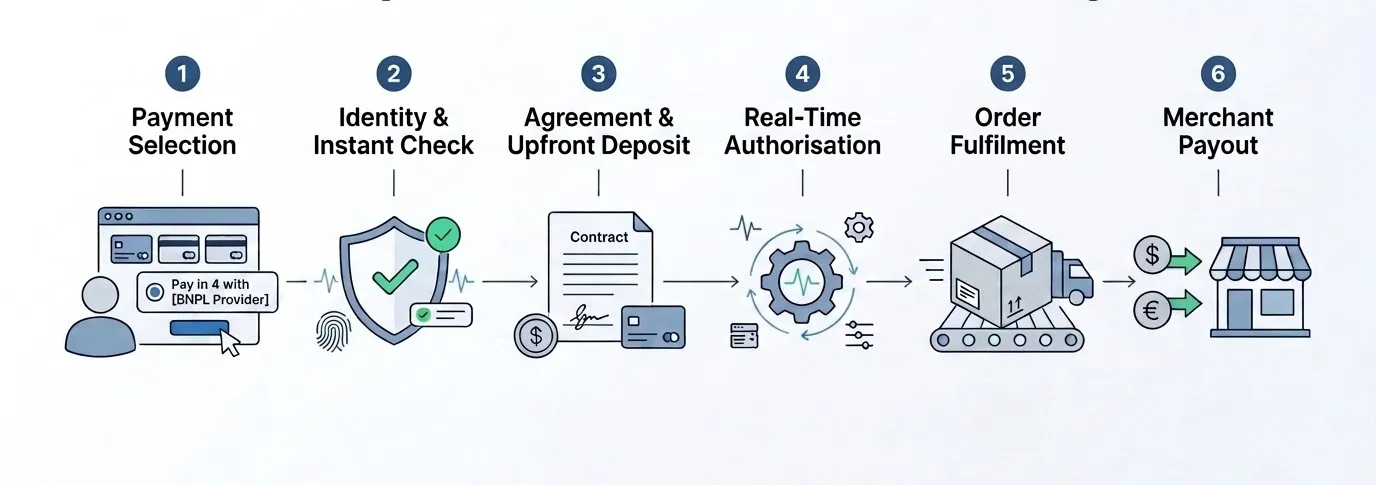
The customer experience during BNPL services often feels like just completing a simple instalment transaction. But how does the process actually work?
Here is a step-by-step process:
- Payment selection at the checkout: The customer selects BNPL as the payment method once they reach the checkout page alongside other options like credit cards or digital wallets.
- Account creation and credit check: If the customer is a first-time user, they create an account with the BNPL provider within the checkout window. The BNPL provider then conducts a fast credit check to determine the buyer’s credit score and limits.
- Terms acceptance and upfront payment: The approved customer then accepts the BNPL agreement and makes the initial deposit.
- Real-time transaction authorisation: The BNPL provider authorises the order in real time and passes an instant success confirmation back to the e-commerce gateway.
- Immediate order fulfilment: Once the BNPL provider guarantees the payment, the merchant processes and dispatches the order. The customer receives the order within the standard delivery time.
- Merchant settlement: The BNPL provider settles the full purchase amount into the merchant bank account within 1-3 business days, minus their processing fee (merchant discount rate). From this point, the BNPL provider manages the instalment collection, meaning that the merchant doesn’t encounter credit or default risks.
What are the benefits of BNPL services?
BNPL allows cross-border businesses to improve customer experiences while also creating various growth opportunities:
Reduce financial and fraud risks
Because the BNPL provider offers the full payment (minus the processing fees), this protects merchants from default and fraud risks. If the customer misses the payments or defaults, the payout remains guaranteed.
Reach more customers
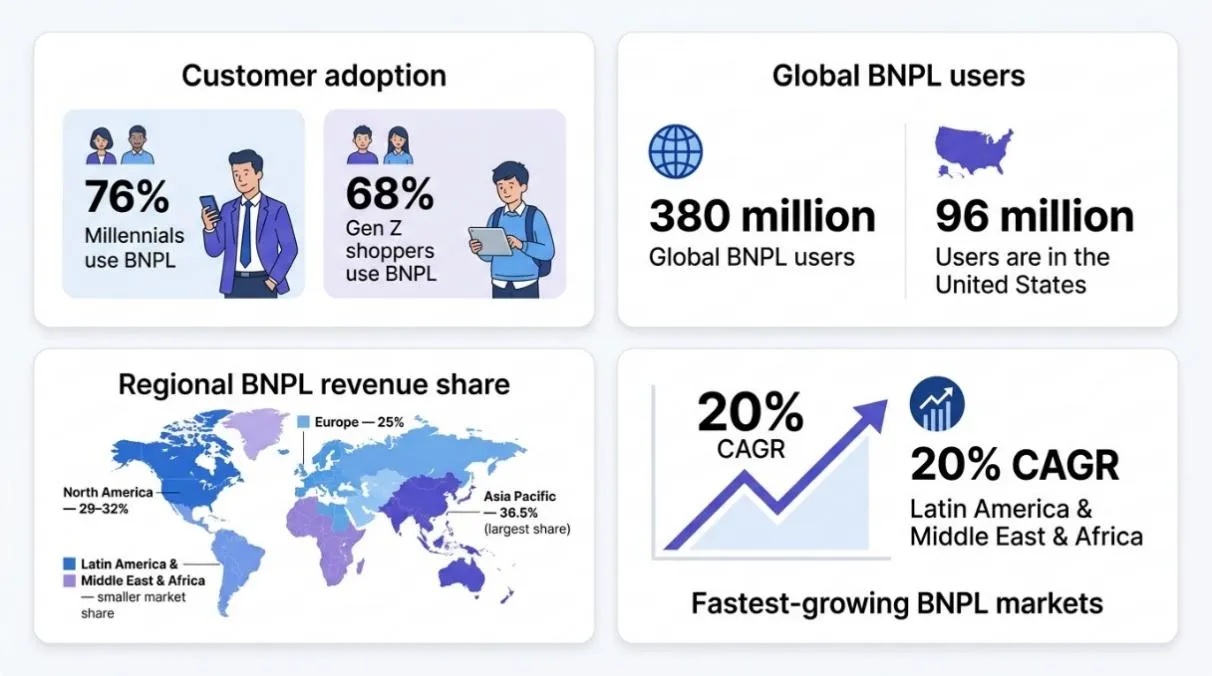
BNPL allows global merchants to reach customers who prefer alternative payment methods over traditional credit cards. For instance, 76% of Millennials and 68% of Gen Z shoppers use BNPL. Out of the approximately 380 million global users, 96 million come from the US.
However, Asia Pacific accounts for the largest share of BNPL revenue (36.5%), followed by North America (29-32%), and Europe (25%). Latin America and MEA (Middle East & Africa) have a smaller market share but represent the fastest-growing regions with a compound annual growth rate (CAGR) of 20%. Therefore, offering BNPL can allow merchants to reach these emerging markets worldwide to improve their sales and overall growth.
Improve customer experience
BNPL payment methods offer a convenient way of accessing financing because providers only subject customers to soft credit checks compared to hard checks for other financing options. They also do not need to send separate applications or incur additional charges, which makes it easy to complete the payment flow in just a few clicks.
Boost the average order value
BNPL allows customers to make large purchases by allowing them to break the cost into manageable instalments that fit their budgets. Thus, projections show that it increases the average order value (AOV) by 20-40%. It also increases conversion rates by reducing checkout friction.
How to know if BNPL is right for a business
BNPL is not a one-size-fits-all solution for all businesses. For example, the merchant discount rate can be too high if a business has low profit margins. So, before deciding to integrate it into the payment system, merchants should assess whether it aligns with their business model.
Here are some considerations to help make this decision:
- Does the average order value justify the transaction fees? If a business sells high-ticket products that cause purchase hesitation, BNPL may deliver higher ROI.
- For businesses that target credit-averse or younger demographics, offering BNPL options can reduce cart abandonment.
- If cross-border sales are a key growth driver, local payment habits should influence a merchant’s checkout system. This means that if the target market has high BNPL preference, then the merchant should consider integrating it into their payment flow.
How to choose the right BNPL provider
As a global merchant, a BNPL provider works as a significant growth partner. This is because BNPL services can affect a global merchant’s conversion rates, help them capture local markets, and ensure they maintain healthy profit margins. Therefore, when selecting a BNPL partner:
Choose providers that support target markets
Who is the business’s target customer and where are they located? Once a merchant understands this, they can then select a provider offering services in these locations. Also, they must consider localised options and multi-currency processing because customers are more likely to prefer familiar payment methods.
For example, Antom supports various online payment integrations, including BNPL. Partnering with Antom can allow you to offer localised payment methods in over 200 markets. The platform supports more than 300 payment methods and handles 140+ currencies. Therefore, businesses can easily scale internationally and access high-growth cross-border regions through a single gateway. This eliminates the challenges of managing separate merchant accounts and technical integrations.
Evaluate repayment options
Different product categories can require varying repayment models. For example, short-term payments can work well for low-ticket items. However, high-value purchases like consumer electronics and furniture may require long-term options. Ensure that the provider offers options that align with the products or services you offer.
Consider credit policies and spending limits
A provider’s credit decision engine directly impacts a store’s checkout approval rates. Providers with rigid credit filters are more likely to have higher rejection rates. They may even reject valid buyers, creating unnecessary checkout friction.
Also remember that their credit check and scoring systems determine a buyer’s spending limits. If the assigned limits are too low, customers may still be unable to complete the purchase, even with the BNPL option available. So, ask the providers for their average transaction approval rates in your target markets before you decide to partner with them.
Assess integration and checkout experience
How easy is it to integrate the BNPL option into the payment system? Some providers allow a single integration while others may have a more complicated process. Also, a merchant’s technical setup and customer profile can influence the integration because different e-commerce platforms require different levels of developer support and customisation.
Look for strong security and compliance capabilities
The selected BNPL provider should comply with appropriate regulations, such as PCI DSS Level 1 standards and local data privacy laws. This compliance protects businesses and their customers from potential risks associated with online transactions. Therefore, global merchants should consider looking for partners with built-in risk control capabilities, real-time transaction security, and automated fraud detection systems.
Final takeaway
BNPL is evolving into a growth engine for global merchants. This alternative payment method removes the upfront cost barrier that makes customers hesitate to complete a transaction, especially when shopping for high-value products. It also increases conversion rates and reduces cart abandonment, thus directly contributing to a business’s financial performance. However, merchants must partner with BNPL providers whose services align with their growth goals. For example, they should be available in your target markets, offer justifiable processing rates, and support localised payment options like digital wallets and cards.
Ready to simplify your global BNPL and payment strategy with Antom? Contact us now!
FAQs
1. How does BNPL affect payment reconciliation and financial reporting?
Most BNPL providers use net settlement, deducting their transaction fees upfront before depositing a single lump sum into the merchant's bank account. Therefore, merchants should reconcile these payouts with individual transactions using the provider's settlement reports or transaction references.
2. How do cross-border currency conversions work for international BNPL purchases?
When a customer makes an international BNPL purchase, the provider processes the transaction in the merchant’s local currency. They then automatically convert the amount to the customer’s home currency and charge them conversion or cross-border fees.