
Share on
Digital marketing in 2026 is no longer just using online channels to promote your product or service. It is now a connected growth system that uses data, automation, AI, customer experience, and payment readiness to grab digital attention from the right crowd and turn that demand into revenue.
Thankfully, with the help of AI you can now act on customer behaviour faster. However, revenue still depends on whether checkout matches how customers prefer to pay, especially for cross-border businesses. With digital payments rising from 34% to 66% of global e-commerce value between 2014 and 2024, payment preference is now part of your marketing conversion journey.
So how do you navigate future-proof digital marketing in the age of AI, especially when your customers expect lower payment friction?
This article will explain everything you need to know about digital marketing in 2026, what changed, and how cross-border businesses can connect marketing strategy with payment strategy in a future-proof way.
What is Digital Marketing in 2026?
Digital marketing is the process of using online channels, digital tools, and customer data to attract and convert customers. In simple terms, it connects a business with its customers through digital touchpoints like social media, search engines, business portals, marketplaces, and checkout experiences.
- Digital marketing covers a wide range of activities, including:
- Search Engine Optimisation (SEO) to help businesses improve their visibility in search results.
- Paid advertising for reaching targeted audiences through platforms such as Google, LinkedIn, Meta, and TikTok.
- Content marketing for educating and attracting potential customers through the use of articles, videos, guides, and other resources.
- Email marketing for nurturing leads and retaining existing customers.
- Social media marketing to build brand awareness and engagement across social media.
Recently these touchpoints have become more complex because buyers not just move across many platforms before making a decision but also look for solutions in an entirely new platform: AI chat tools like ChatGPT.
As digital behaviour evolves with the wide use of AI, new disciplines like Answer Engine Optimisation (AEO) are evolving. AEO focuses on creating content that can be understood, cited, and surfaced by AI-powered search engines and assistants. Businesses are also adapting to Generative Engine Optimisation (GEO), which aims to improve visibility within AI-generated responses rather than traditional search rankings alone.
For B2B merchants, there is also another important layer. Digital marketing must now work with payment experience. A campaign can create interest, but the wrong payment method, weak acquiring coverage, failed authentication, or poor risk controls can still reduce conversion.
How is AI changing the rules of Digital Marketing for cross-border business
Google's recent updates suggest that the future of search will be shaped by AI-first, agentic experiences. At the same time, ad platforms are introducing more AI-powered tools to improve targeting, speed up optimisation, and drive better outcomes. AI is influencing how you approach digital marketing strategy.
Marketing teams used to plan and implement digital marketing strategies manually. They researched keywords, wrote content, created ads, reviewed reports, and made campaign changes based on past performance. AI now automates many of these tasks.
More interestingly, digital marketing is becoming more predictive. Instead of only asking what happened last month, you can now identify which audience is most likely to convert, which market needs localised messaging, which lead should sales contact first, which payment method may work best in a region, and which campaign is likely to waste budget.
As a B2B merchant, you can use AI to target audiences more accurately and streamline your long and expensive buying cycles. A small improvement in lead quality, conversion rate, payment success rate, or customer retention can heavily impact your sales.
Here are some important changes AI has brought to digital marketing that you should know about:
AI search is changing SEO and content strategy
AI-powered search is one of the most important recent changes in digital marketing. Search engines and AI assistants are increasingly answering questions directly. This means businesses can’t depend only on traditional search engine rankings.
SEO still matters, but it's no longer enough. You now need content that can be understood, summarised, trusted, and cited by AI systems.
For example, a packaging supplier may want to rank for "sustainable packaging for e-commerce businesses." But in an AI search environment, the company also needs to answer deeper questions, such as which packaging materials are most sustainable, how packaging affects shipping costs, and what regulations apply in different countries.
The new change rewards content that is specific and useful. Generic articles with repeated keywords are less effective. Furthermore, you now create content to become a trusted source in your category, not just to appear in search engines. For an effective AI-ready content strategy, include topic clusters around key business problems.
Content marketing is moving from volume to authority
AI tools make it easier to create content quickly. As a result, many businesses are publishing large amounts of average content to gain visibility. But in 2026, volume alone rarely builds trust.
Buyers need content that helps them make decisions. They want to understand risks, compare options, justify spending, and avoid costly mistakes. A generic blog post is unlikely to influence search engines, AI systems, or a serious buyer.
Effective B2B content marketing should focus on authority rather than pure output. This means creating and distributing quality content that comes with data, expert analysis, clear frameworks, market context, and practical recommendations.
Personalisation is becoming a revenue driver
Personalisation isn't about using a customer's name in an email anymore. Today, businesses use AI to personalise messaging, offers, website journeys, product recommendations, and follow-up communication.
Personalisation is important because different buyers have different concerns. For instance, a CFO may care about cost, risk, and reporting, and a marketing manager may care about conversion and campaign performance. While an operations team may care about integration, settlement, and support.
AI helps you identify these differences and respond with more relevant and personalised messages or content.
Payment personalisation matters too. A customer in Indonesia may expect GoPay, OVO, DANA, ShopeePay, or account-to-account options, while a Thai buyer may prefer PromptPay, card, K PLUS, or local wallet options. If the checkout does not reflect local habits, your marketing campaign may bring traffic but still lose orders.
Build a cleaner data foundation, and connect marketing, sales, customer support, website analytics, and payment data where possible to give AI a better view of the customer journey and help teams make more accurate decisions.
Paid advertising is becoming more automated and more competitive
Platforms such as Google, Meta, LinkedIn, TikTok, and programmatic ad networks are using more automation for targeting, bidding, creative testing, and campaign optimisation.
While this can help businesses improve efficiency, it also creates a risk. If everyone uses the same automated tools, differentiation can become harder.
If you're running paid ads for your business, connect your customer data with tools like Meta Conversions API. This helps platforms look beyond clicks and form submissions to understand what happens after a lead enters your funnel, whether they convert, stall, or drop off. With this data, ad platforms can better identify your real customers and optimise future campaigns toward similar high-value leads.
Don’t forget to include payment outcomes where possible. If a campaign drives many checkout starts but customers fail at payment, the issue may not be the ad. It may be the payment method mix, acquiring route, authentication step, currency display, or fraud rule.
Data, privacy, and trust are becoming more important than ever
As AI becomes more common, trust has become a real concern since businesses are collecting more customer data, using more automation, and relying more on AI-generated outputs.
Customers want relevance, but they also expect privacy, transparency, and control. Regulators are also paying closer attention to how companies collect, store, and use data.
In 2026, you must know where customer data comes from, how it is stored, who can access it, and how AI tools use it. This is especially important for businesses operating across multiple regions because data rules may differ between markets.
Payments add another trust layer. Merchants need secure payment processing, fraud checks, clear settlement records, chargeback handling, and compliant handling of payment data.
Why payment strategy now affects digital marketing ROI
Digital marketing creates demand, but payments decide how much of that demand becomes revenue. And as a cross-border merchant, you know payment habits can change sharply from one market to another.
For instance, the chart below shows how digital wallet adoption varies across markets for e-commerce payments.
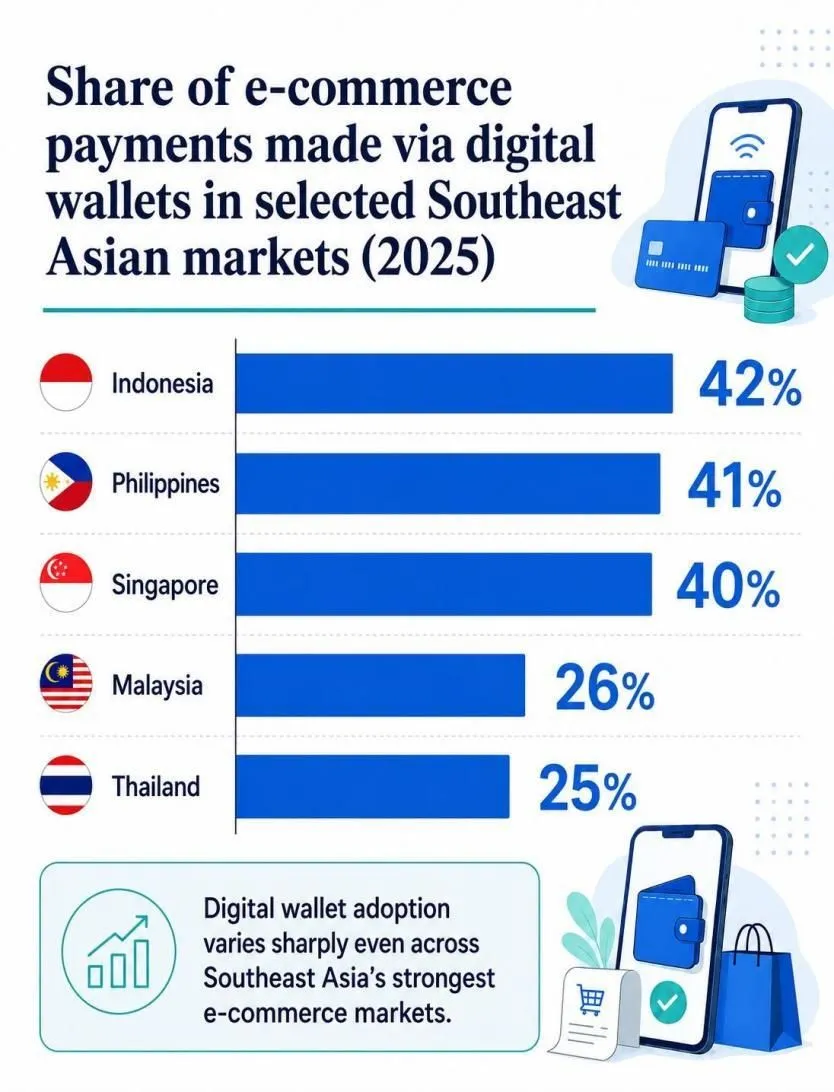
Similarly, EBANX's Southeast Asia payments analysis states that digital wallets represent 42% of Indonesia's e-commerce value, while cards represent less than 5% of transactions. In contrast, 2C2P's Thailand payment methods analysis says digital wallets make up an estimated 29% of Thailand's e-commerce transaction volume in 2026. Furthermore, Mordor Intelligence reports that the top five mobile payment players, GoPay, OVO, ShopeePay, DANA, and LinkAja, controlled around 70% of the Indonesian mobile payments market in 2025, with no single wallet above 25%.
This explains why digital marketing and payment strategy need to be planned together. A marketing team may localise ads, landing pages, and offers, but if checkout does not support local payment preferences, the campaign can still lose high-intent buyers.
Local payment methods can improve conversion in cross-border markets
Local payment coverage can be crucial, especially in markets where card penetration is lower or where wallets and bank transfers are part of daily digital behaviour. This includes many parts of Southeast Asia, the Middle East, and emerging digital commerce markets.
Acquirers and payment service providers such as Antom can help merchants connect marketing campaigns to local payment processing. Antom supports over 200 payment markets, more than 300 payment methods, and 140+ currencies through a single gateway.
Payment pitfalls that can hurt marketing performance
Many companies treat payment as a technical task that comes after marketing. This can create hidden conversion loss because a campaign isn’t successful until the customer completes the checkout.
Common payment problems include a limited payment method mix, weak local acquiring coverage, unclear currency display, failed authentication, strict fraud rules, poor retry logic, and a lack of clear reporting.
As a result, paid ads become more expensive because fewer visitors convert. SEO traffic becomes less valuable because high-intent visitors abandon checkout. Retargeting becomes less accurate because the business cannot tell whether a customer lost interest or failed at payment.
You should therefore measure payment performance alongside marketing performance. A useful dashboard should show traffic source, checkout starts, payment method selected, approval rate, decline reason, fraud decision, chargeback trend, and successful revenue. When choosing a payment service provider, look beyond the basic ability to accept cards.
How subscription and repeat payments fit into digital marketing
Digital marketing strategy should never be limited to just closing a deal. Actual growth depends on repeat payments and customer lifetime value.
A low-cost lead can’t always be valuable if the first renewal fails. Whereas, a high-cost campaign may still be profitable if the customer stays for several months and payments continue successfully.
Subscription payment solutions can support automated recurring payments through e-wallets, bank cards, and other local payment methods. This gives you a way to connect customer acquisition with long-term revenue, instead of only focusing on the first transaction.
The future of digital marketing for B2B merchants
In 2026 and beyond, businesses will use AI to understand markets faster, personalise buyer journeys, improve campaign performance, reduce friction, and increase customer lifetime value. But they will also keep human judgement at the centre.
For B2B merchants, digital marketing will become more closely connected to payments, customer experience, data governance, and international expansion strategy.
That means the best digital marketing strategy isn’t just about better ads, better content, or better automation. It’s also about making sure customers can complete the action your campaign asks them to take. And for cross-border businesses, including payment strategy is now part of digital marketing performance.
If you serve customers across multiple international markets, Antom can help you support local payment preferences and convert more marketing-driven demand into completed transactions. Explore Antom's cross-border payment solutions today!
FAQ
What is digital marketing in 2026?
Digital marketing in 2026 is the use of online channels, customer data, AI, automation, and digital experiences to attract, convert, and retain customers.
How can digital marketing improve payment conversion in Southeast Asia?
Digital marketing can improve payment conversion by matching campaigns, landing pages, and checkout options to local buyer behaviour. In Southeast Asia, this often means supporting local wallets, QR payments, account-to-account methods, banking apps, and local currency experiences.
Why should merchants consider payment methods before scaling campaigns?
Merchants should consider payment methods before scaling campaigns because paid traffic can become expensive if buyers cannot complete checkout. Local payment method coverage, acquiring quality, fraud rules, and recurring payment support can all affect the real ROI of digital marketing.