

Share on
Today’s airline merchants operate in one of the most complex payment environments. Challenges like high cart abandonment and fragmented cross-border payment rails can quietly eat into their profit margins.
Thankfully, checkout performance has become a direct revenue lever. Even minor improvements in authorisation rates or payment success can significantly improve booking flows. According to a cross-border payment analysis, even a 1% increase in card authorisation success can recover up to £10 million in pure revenue for a merchant processing £1 billion annually. This can happen without spending a penny more on customer acquisition.
This article examines five key payment trends shaping the airline commerce infrastructure. It also sheds light on how merchants use modern payment orchestration to improve approval rates and scale internationally.
The Rapid Evolution of Airline Payments
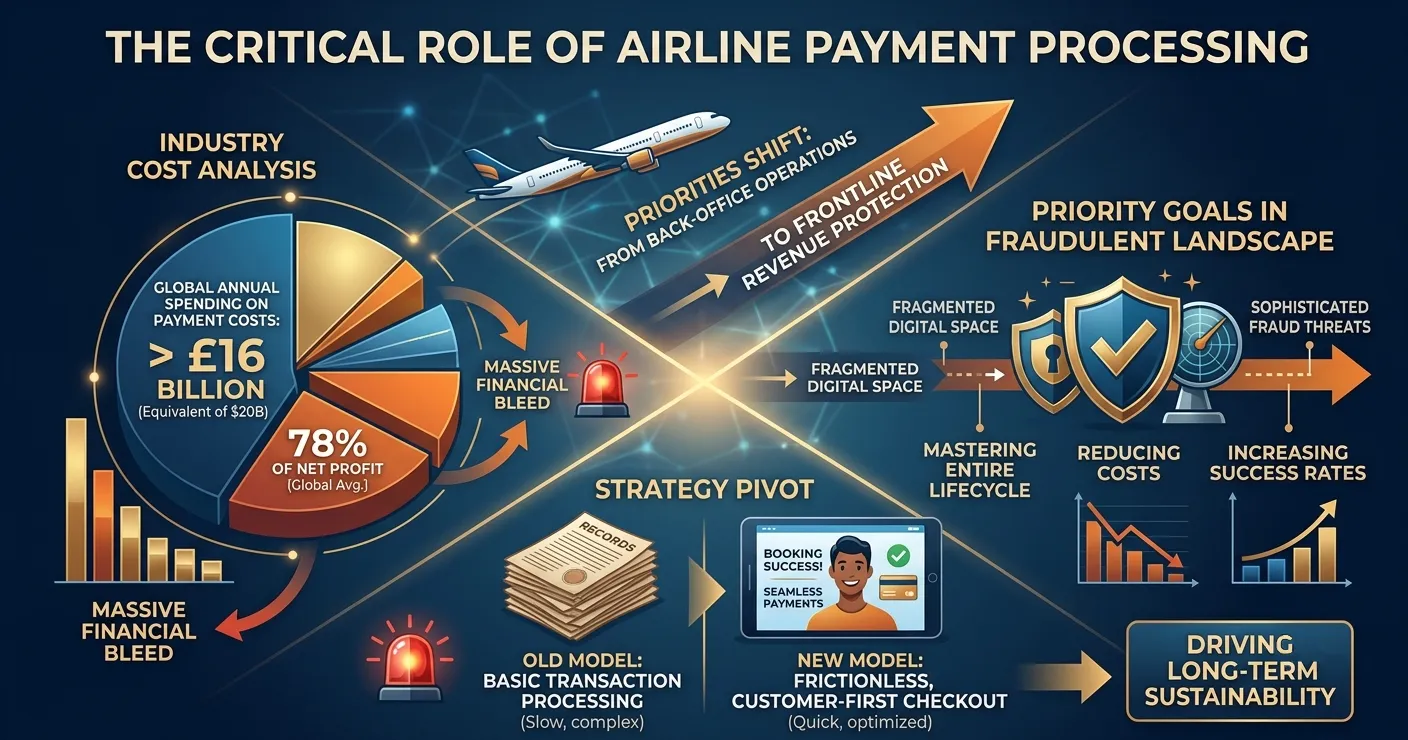
Payment processing always happened behind the scenes of airline operations. Today, however, it has become a strategic function that directly influences revenue protection and international growth.
This change happened due to an increasingly fragmented digital payment landscape. It invites more sophisticated fraud. Because of this, the priorities of airlines have fundamentally changed. Now, it’s about mastering the entire payment lifecycle to reduce costs and increase success rates across every market.
Quite interestingly, airlines worldwide spend more than $20 billion each year on payment costs. This makes up around 78% of the industry’s net profit. And reducing these costs will pave the way towards long-term sustainability.
One way to combat this massive financial bleed is to change how airlines handle their payments. They are shifting their focus from basic transaction processing to a frictionless payment experience.
The Top 5 Flight Payment Trends to Watch Right Now
It makes sense that the aviation industry is undergoing a massive checkout overhaul. Listed below are the five game-changing payment trends that can eliminate friction and modernise their system:
Trend # 1: Smarter Payment Solutions with Fintech
Airlines are fast becoming fintech operators. Carriers are ditching legacy infrastructure to partner directly with massive financial technology platforms. One platform doing this quite well is Antom. It’s an AI-powered global payment provider that allows airlines to process transactions across hundreds of markets. It uses localised methods to ensure that customers can pay in their native currency using their preferred local options without missing a beat.
The table below shows how global fintech platforms are upgrading the traditional airline booking experience:
Feature | Traditional Airline Payments | Fintech-Powered Payments |
Payment options | Rigid, card-heavy checkouts | Direct integration with global methods (wallets, BNPL, local cards) |
Global reach | Fragmented regional payment providers | One unified API connecting airlines to hundreds of markets |
Transaction success | Fixed paths prone to sudden checkout failures | Smart routing driven by AI to dynamically boost approval rates |
Fraud prevention | Clunky verification that slows down booking | Real-time, machine-learning security (like that by Antom Shield) to stop threats instantly |
Becoming a licensed financial institution is a major shift from running an airline. However, for airlines that can make the transition, the rewards could be significant.
Trend # 2: Supporting Diverse Payment Methods
Airlines are expanding beyond card-centric payment models to support alternative and localised payment methods. These include digital wallets and instalment-based financing.
These flexible payment options are breaking down financial barriers. At the absolute forefront of this movement is the meteoric rise of Buy Now, Pay Later (BNPL) services and structured instalment plans.
According to recent industry data, the global BNPL market is expected to skyrocket to a staggering $560.1 billion in transaction volume.
Global fintech platforms like Antom are driving this democratic shift by connecting airlines to a network of over 300 regional and alternative payment methods via a single API. This allows carriers to offer region-specific payment plans. They can align with the financial preferences of their partners or suppliers in other regions.
The end result is a win-win scenario. Airlines can localise payment experiences without building individual integrations per market.
Trend # 3: Higher Focus on Data Security and Privacy
As airlines adopt digital wallets and flexible financing, they also become prime targets for highly sophisticated cybercriminals. In the modern aviation ecosystem, data security is a critical pillar of the payment experience.
Problems like account takeovers, synthetic identity scams, and cross-border payment fraud are on the rise. This is forcing airlines to move away from reactive defence mechanisms. Visa's Net MIS Fraud Insights revealed that European airline fraud losses climbed to a staggering $77.7 million in a single year. A spike like this proves that fraudulent attacks are becoming incredibly precise and financially devastating.
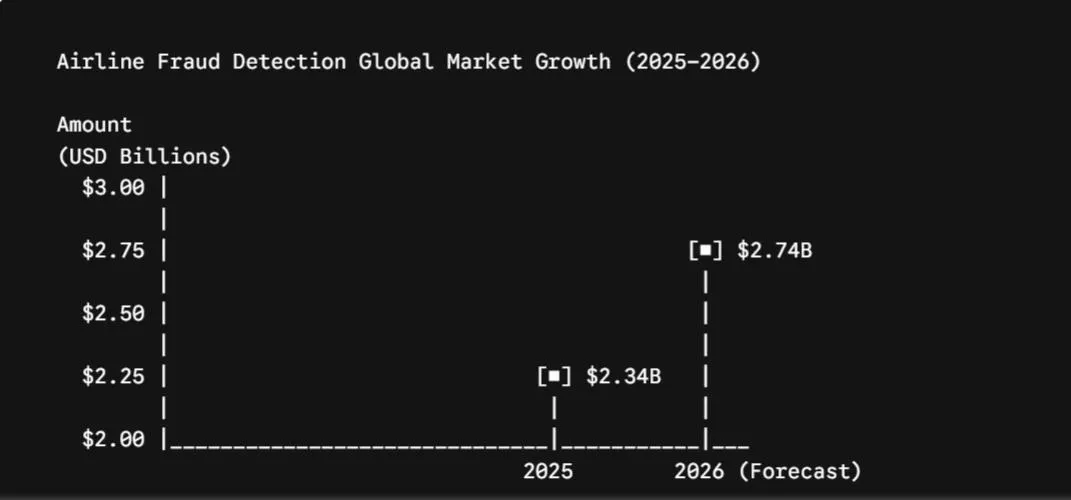
This is why carriers are heavily investing in specialised defence infrastructure. In fact, the global airline fraud detection market is undergoing an aggressive expansion to counter these threats:
Airline merchants are now using methods like:
- Network Tokenisation: Swapping sensitive card details with secure digital tokens so hackers can't steal raw data.
- AI-Driven Risk Scoring: Platforms like Antom are providing a robust risk management layer. They instantly analyse transaction patterns. This allows them to block scammers at the exact millisecond of booking while genuine transactions proceed without interruption.
- Biometric Verification: Using facial recognition and fingerprint scans to ensure the person making the payment is actually the cardholder.
Filtering threats behind the scenes allows airline carriers to remove checkout friction and keep the payment system protected.
Trend # 4: The Rise of Payment Orchestration
Managing a global airline’s finances is an operational puzzle. A single airline might sell tickets in over 100 countries. This requires it to handle dozens of local currencies and unique regional payment preferences. Historically, this meant connecting separate software pipelines for every single payment gateway or bank. It eventually created a messy, high-maintenance backend.
Payment orchestration platforms (POPs) are making things easier. This technology acts like an air traffic controller for data. They unify all disparate payment channels, local gateways, and fraud detection tools into a centralised smart platform.
Orchestration keeps bookings effortless with two main functions:
- Smart Routing: If a business in Brazil transfers the money and the primary payment gateway suddenly fails, an orchestration engine automatically redirects the transaction to an alternative local gateway in a fraction of a second. The business never notices a glitch. This way, the airline avoids losing a sale.
- Unified Expansion: Airlines don’t have to write custom code for each new regional payment preference. They can now activate hundreds of local digital wallets and alternative payment methods with a single orchestration layer. This accelerates their time-to-market while reducing integration overhead.
Trend # 5: The Rise of Embedded Financial Services
Airlines are increasingly embedding financial services directly into booking and post-booking journeys. In other words, they are quietly transforming into one-stop digital shops. This mainly happens by adding financial services directly into the booking process.
For example, they allow:
- Travel insurance at checkout
- Instalment financing for bookings
- Loyalty-linked financial benefits
These operations mainly happened on third-party websites. But now, airlines handle most of them. Industry data from Mordor Intelligence notes that traditional payment methods, such as paper checks and corporate bank wires, still accounted for 64.78% of total B2B payment volume.
This percentage is declining because digital API rails and digital cards are rapidly narrowing the gap. It reflects how airlines are now embedding financial services to facilitate their partners.
To deliver these embedded services efficiently, airlines can leverage modular payment infrastructure. Antom, for instance, provides an API architecture that allows carriers to plug in multi-currency pricing, real-time FX conversion, and loyalty point redemption directly at checkout. This keeps the entire transaction within the airline’s digital ecosystem, preserving brand control while creating new ancillary revenue streams.
Conclusion
Airline payments are now a core driver of conversion, cost efficiency, and international scalability. Trends like flexible payments and payment orchestration are a sign that modern airlines are trying their best to stay ahead of the competition.
They want to provide friction-free experiences for their partners and suppliers to maintain the relationship. This means providing more choices at every stage of the payment journey. Airlines that invest in fast and secure payment solutions will be better positioned to improve customer satisfaction and drive long-term growth.
Frequently Asked Questions (FAQs)
Why are virtual cards now widely used in airline B2B payments?
Virtual cards provide better security and easier reconciliation than traditional corporate cards, as each payment can be linked to a unique transaction. This reduces fraud and simplifies accounting for travel agencies and corporate travel managers.
What is the role of payment regulations in global airline operations?
Airlines operating across multiple markets must comply with varying payment regulations, including PCI DSS, Strong Customer Authentication (SCA), and local financial laws. Meeting these standards reduces compliance risk and keeps cross-border transactions smooth.
What are the specific requirements for an airline to become a licenced financial institution?
Airlines must secure Electronic Money Institution (EMI) or banking licences from regional regulators to operate as a licensed financial institution or fintech operator. This means they have to meet strict capital reserve requirements and compliance standards, such as anti-money laundering (AML) laws.