


Share on
Cross-border shipping payments involve far more complexity than a single transaction between buyer and seller. Multiple currencies, stakeholders, banking systems, and regulatory environments interact on every international freight movement, and when any part of that chain breaks down, the cost falls on the merchant.
This article looks into how global B2B merchants can reduce payment risk and processing errors by building smarter shipping payment infrastructure, from standardising data capture to monitoring settlement performance across corridors.
Why Shipping Payment Systems Matter in Global Trade
Global supply chains have grown significantly more complex over the past decade. Cross-border e-commerce volumes continue to rise, freight corridors have multiplied, and B2B merchants are now managing supplier and logistics partner relationships across dozens of markets simultaneously.
Shipping payments sit at the intersection of logistics, fulfilment, and freight settlement. Every time goods move across a border, a corresponding payment flow is triggered to carriers, freight forwarders, customs brokers, warehousing operators, and ground handlers.
Each of those payments carries its own timeline, currency, compliance requirement, and failure mode.
How Shipping Payments Work in Cross-Border Logistics
A single cross-border shipment involves a chain of payment relationships rather than a single transaction. The merchant initiates the process, paying logistics providers for freight services and fulfilment partners for warehousing and last-mile delivery.
Freight forwarders coordinate the movement of goods and invoice separately for their services, consolidating charges from multiple carriers into a single billing arrangement.
Customs brokers handle import and export documentation, with their fees settled independently. Underlying all of this are acquiring banks, which process the actual payment transactions and sit within the regulatory frameworks of each jurisdiction involved.
Common Shipping Payment Challenges for Global Merchants
The challenges that emerge from this multi-party structure are well-documented among cross-border merchants. Settlement delays are among the most common: payments moving across international banking networks don't always arrive within expected timeframes, and when they don't, the downstream effects on cash flow and partner relationships can be significant.
FX conversion errors occur when exchange rates aren't locked at the point of invoice approval, or when conversion markups applied by intermediary banks aren't visible until settlement.
Reconciliation mismatches arise when payment reference numbers, invoice identifiers, or currency formats differ between systems; this is a frequent problem when merchants are managing multiple logistics partners across multiple regions without a unified payment platform.
Payment failures add another layer of complexity. High-value B2B transactions are declined more frequently than consumer payments, particularly when crossing banking systems with different risk thresholds or compliance requirements.
And compliance risks: sanctions screening, KYB obligations, and data localisation rules vary by corridor and can delay or block legitimate payments when not managed proactively.
Taken individually, each of these challenges is manageable. Across a high-volume cross-border operation, they compound quickly.
Key Risks in Cross-Border Shipping Payments
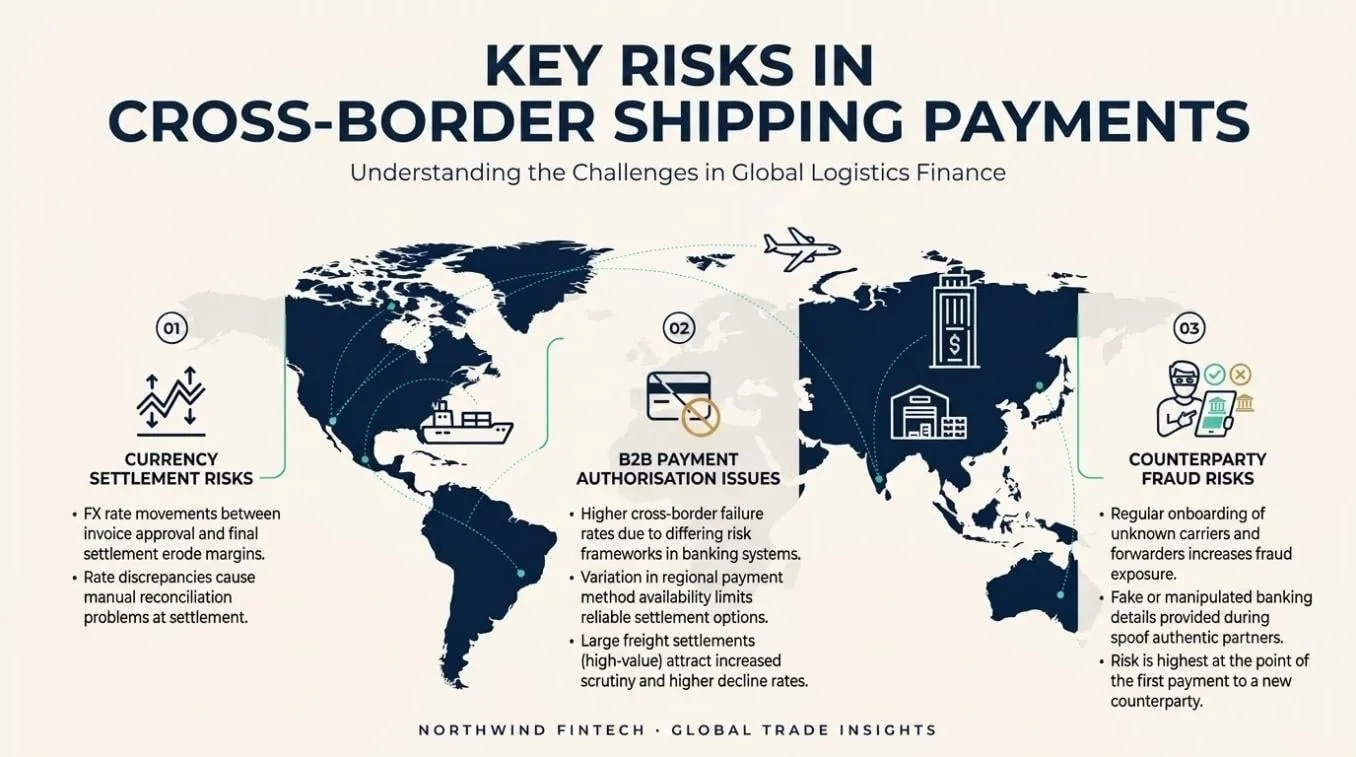
Foreign Exchange and Multi-Currency Settlement Risks
Most cross-border shipping payments involve at least two currencies, and often more. When conversion happens at the point of settlement rather than at invoice approval, merchants are exposed to rate movements over the intervening period. On a single transaction, the difference may be marginal.
Exchange rate discrepancies also create reconciliation problems. When the FX rate applied at payment differs from the rate used in the original invoice, the settled amount doesn't match the invoiced amount, triggering a mismatch that has to be investigated and resolved manually.
Payment Failures and Authorisation Issues
Payment failure rates in cross-border B2B transactions are meaningfully higher than in domestic contexts. Banking systems across different countries operate under different risk frameworks, applying different authorisation criteria to incoming international transactions.
Variation in payment method availability adds further complexity. A payment method that works reliably for settling with logistics partners in Southeast Asia may not be available, or may perform poorly, when applied to freight settlement in Eastern Europe or the Middle East.
High-value B2B transactions are particularly exposed. Large freight settlements trigger additional scrutiny from acquiring banks and card networks, increasing the likelihood of a decline or a request for additional verification.
Fraud and Counterparty Verification Risks
Cross-border logistics operations require merchants to regularly onboard new payment counterparties: carriers, freight forwarders, customs agents, and fulfilment partners across markets with which they may have limited direct experience. Each new relationship is a potential fraud exposure, and the risk is highest at the point of first payment.
The most common fraud vectors in this context involve fake or manipulated banking details. A new logistics partner provides account information that has been spoofed or redirected. Once a payment moves to a fraudulent account across international banking channels, recovery is slow and mostly unsuccessful.
Best Practices to Reduce Shipping Payment Errors
Centralise Global Shipping Payment Operations
Managing cross-border shipping payments across multiple disconnected systems is one of the most reliable ways to accumulate reconciliation problems. Centralising onto a unified payment platform addresses this directly. A single platform across all corridors means payment data is consistent, reconciliation happens in one place, and finance teams aren't spending time aggregating information from multiple provider dashboards.
The operational benefits extend beyond reconciliation. Centralised payment operations make it easier to enforce consistent payment terms, apply standardised fraud controls, and identify performance patterns across corridors, all of which are harder when payment infrastructure is fragmented.
Standardise Payment Data and Reconciliation Processes
A significant proportion of cross-border payment errors originates not in the payment system itself, but in the data that enters it. Inconsistent invoice numbering, mismatched payment reference numbers, currency fields formatted differently across systems, and account details entered without validation checks all create downstream reconciliation problems that are entirely avoidable.
Establishing clear standards for how payment data is captured: consistent invoice numbering conventions, mandatory reference fields, validated banking detail formats, removes much of this friction at source.
Automated reconciliation processes build on this foundation. When payment data is standardised, matching transactions against invoices and shipment records can be done systematically rather than manually, flagging discrepancies in real time rather than surfacing them during a month-end review.
Segment Payment Flows Based on Risk Profiles
Applying the same payment controls to every transaction regardless of risk profile is both inefficient and ineffective. A recurring settlement with an established fulfilment partner in a well-understood market carries different risk characteristics than a first-time payment to a new customs broker in a market the merchant is entering for the first time.
Risk-based segmentation means applying verification and scrutiny proportionate to the actual risk of each payment. New counterparties warrant enhanced due diligence; additional identity verification, independent banking detail confirmation, and screening against relevant sanctions lists.
High-value transactions above defined thresholds may require secondary approval. Payments into markets with elevated fraud risk profiles or less mature banking infrastructure benefit from additional monitoring.
Monitor Settlement Timelines Across Corridors
Settlement timelines vary significantly across payment corridors, and the gap between expected and actual fund arrival is where cash flow problems develop. Active monitoring means tracking expected settlement dates against actual arrivals in real time, with automated alerts when timelines fall outside expected parameters. That early warning gives finance teams the opportunity to investigate and escalate before a delay becomes a cash flow event, rather than discovering the problem at month-end when options for resolving it quickly are limited.
Payment speed differences across regions are also worth factoring into commercial planning. If a specific corridor consistently settles two to three days later than others, building that into cash flow forecasts reduces the likelihood of being caught short.
How Modern Payment Infrastructure Supports Global Shipping Payments
Modern payment infrastructure has made many of the risks described above significantly more manageable, primarily through payment orchestration; the ability to route transactions intelligently across multiple acquiring banks and local payment networks rather than relying on a single processing relationship.
Orchestration addresses several problems simultaneously. When a transaction fails through one acquirer, it can be automatically rerouted through an alternative without manual intervention.
Local payment networks can be accessed directly, improving authorisation rates in markets where international card schemes perform less reliably. Settlement can be managed across multiple currencies through a single integration rather than separate arrangements for each corridor.
Antom provides global merchants with access to 300+ payment methods across 200+ markets, supporting multi-currency settlement and intelligent transaction routing. This allows merchants to manage shipping payments and cross-border supplier settlements through a unified payment infrastructure, reducing the complexity and overhead that comes with managing multiple disconnected payment relationships across regions.
The Role of Data and Payment Analytics in Reducing Shipping Payment Risks
Payment data is one of the most underused operational resources available to cross-border merchants. Most businesses collect detailed transaction records, but few analyse that data systematically enough to act on it.
Error rate analysis by corridor reveals which payment routes are generating disproportionate failures or reconciliation issues, enabling merchants to address the root cause rather than managing the symptoms. Settlement performance data, tracked over time, makes corridor-level timing patterns visible.
Payment corridor performance analysis supports routing optimisation. When merchants can see which combinations of payment method, acquirer, and market are delivering the best authorisation rates and settlement speeds, they can adjust routing logic accordingly, reducing failure rates and improving the reliability of payments to logistics partners.
Frequently Asked Questions
What are shipping payments in cross-border commerce?
Shipping payments refer to the financial settlements made between merchants, logistics providers, freight forwarders, customs brokers, and carriers involved in moving goods across borders.
Why do shipping payments fail in cross-border transactions?
Failures commonly result from differences in banking infrastructure across countries, unsupported payment methods in specific markets, fraud filters misidentifying legitimate international transactions, or high-value B2B transactions triggering additional scrutiny from acquiring banks.
How can merchants reduce cross-border shipping payment risks?
The most effective approach combines centralised payment operations, standardised data capture, risk-based transaction segmentation, and active settlement monitoring.