
Share on
Global e-commerce growth opens doors for merchants in all parts of the world. With the right strategies, sellers can reach and sell directly to consumers in multiple markets across the world. However, this growth can slow down without the proper payment system. Imagine this: you’re a global merchant located in the U.S., but have customers from Europe or Asia showing interest in your products. If the only payment options available are those common in the U.S., how will these cross-border customers pay for their products?
Therefore, retail payments should be diverse and localised to increase conversion rates. If customers can’t find payment methods they know and can trust, they might abandon the cart. In this guide, you’ll learn about retail payment trends influencing the global e-commerce growth.
What are retail payments?
When customers buy from retail shops, whether online or in-store, the completed transactions are the retail payments. They are everyday transactions that occur between consumers, businesses, and public authorities. Customers can use various methods to make these payments, including cash, payment cards, digital wallets, bank transfers, and other electronic payment solutions. The choice often depends on how and where the purchase takes place and the method accessible to the buyer.
Retail payments encompass a wide range of payment channels and technologies that support secure and convenient transactions across physical stores, e-commerce platforms, and international markets. This table outlines the main types of retail payments and how they support different retail environments:
Retail payment | How it works |
Online retail payments | These are payments customers make through e-commerce websites, mobile apps, or online marketplaces using methods such as cards, digital wallets, bank transfers, or buy now, pay later (BNPL). |
In-store retail payments | These are payments that retailers process at physical retail locations through point-of-sale (POS) systems using cash, cards, contactless payments, QR codes, or mobile wallets. |
Omnichannel retail payments | Omnichannel payments refer to integrated payment experiences that allow customers to move seamlessly between online and offline channels, such as buying online and collecting in-store or using the same payment credentials across channels. |
Cross-border retail payments | These are payments that international customers make after purchasing from retailers in another country. They often involve multiple currencies, local payment methods, foreign exchange, and cross-border settlement. |
Retail payment trends shaping cross-border ecommerce
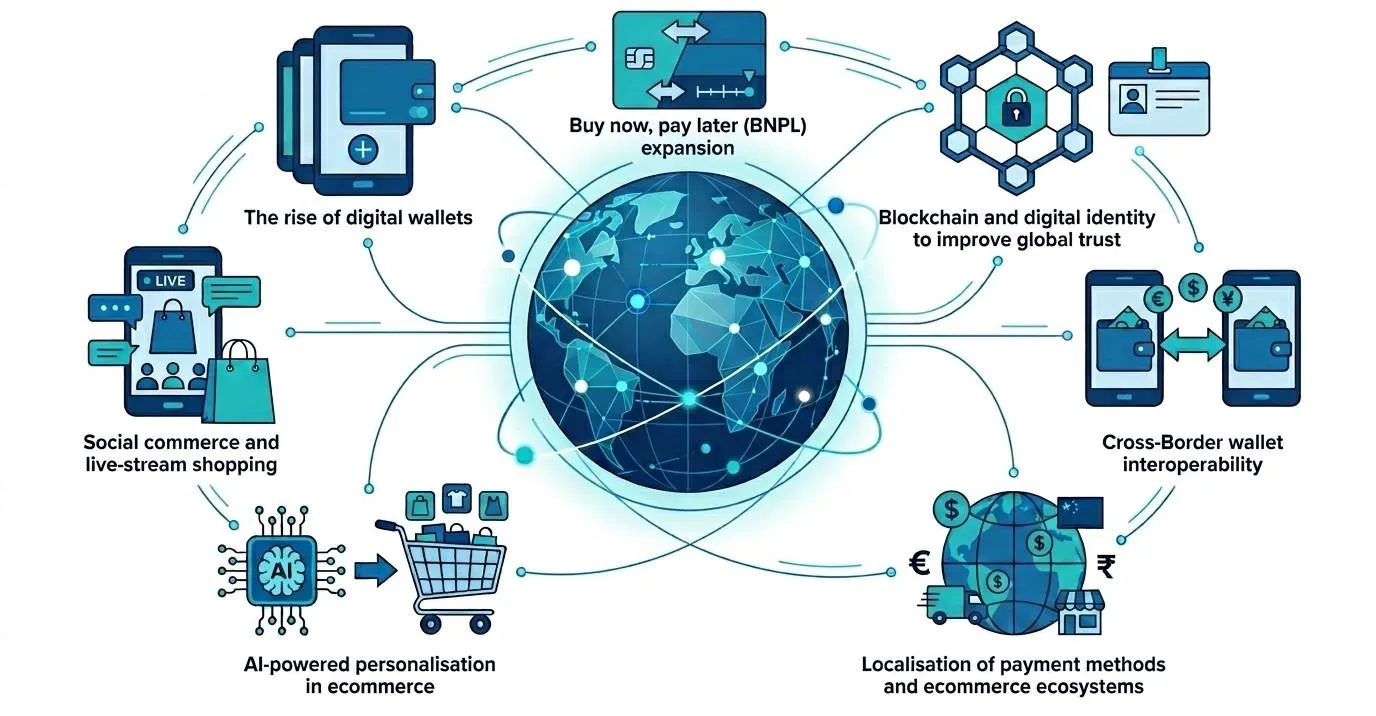
The rise of digital wallets
Digital wallets continue to gain popularity as consumers seek faster, more secure, and more convenient ways to pay online. In 2026, the global digital wallet transaction value will amount to approximately USD 9,851.7 billion. Projections show that it will continue at a compound annual growth rate (CAGR) of 18.9% to reach USD 23,400.3 billion by 2031. This growth reflects the increasing importance of offering digital wallet payment options to meet evolving consumer preferences and improve checkout experiences across international markets
Digital wallets allow customers to store their credit card and bank information on their mobile devices. This makes it easy for them to complete transactions whenever they are shopping. As a result, the number of people adopting digital wallets as a payment method continues to grow rapidly. For instance, the number of digital wallet users in 2025 reached 4.5 billion and will increase to 6 billion, growing at a rate of 35% between 2025 and 2030. With so many people adopting digital wallets, the e-commerce businesses will need to integrate them to improve customer experiences, increase conversion rates, and build consumer loyalty.
Buy now, pay later (BNPL) expansion
Buy now, pay later (BNPL) payment options offer customers great flexibility and reduce the burden of upfront charges. For example, if a customer is looking for a piece of furniture, they can find a store that offers the BNPL option and pay in instalments. This makes the products more affordable and allows customers to make large purchases without financial strain.
The ability to split payments into instalments without interest continues to contribute to BNPL’s adoption among global ecommerce customers. Projections show that the global market value of BNPL will increase from USD 11.9 billion in 2025 to USD 14.9 billion in 2026 and USD 80.1 billion by 2033, growing at a CAGR of 27.2%. Businesses that offer this payment option are more likely to benefit from high-order values and repeat business because customers feel more at ease making substantial purchases.
Blockchain and digital identity
Trust plays a significant role in supporting cross-border transactions. If a customer doesn’t trust your e-commerce business, they will hesitate to provide their payment details. This may lead to abandoned carts, lost sales, and low conversion rates. Blockchain technologies address this challenge by offering verification and digital identity solutions that authenticate items and securely link ownership to verified profiles.
The process occurs in multiple steps:
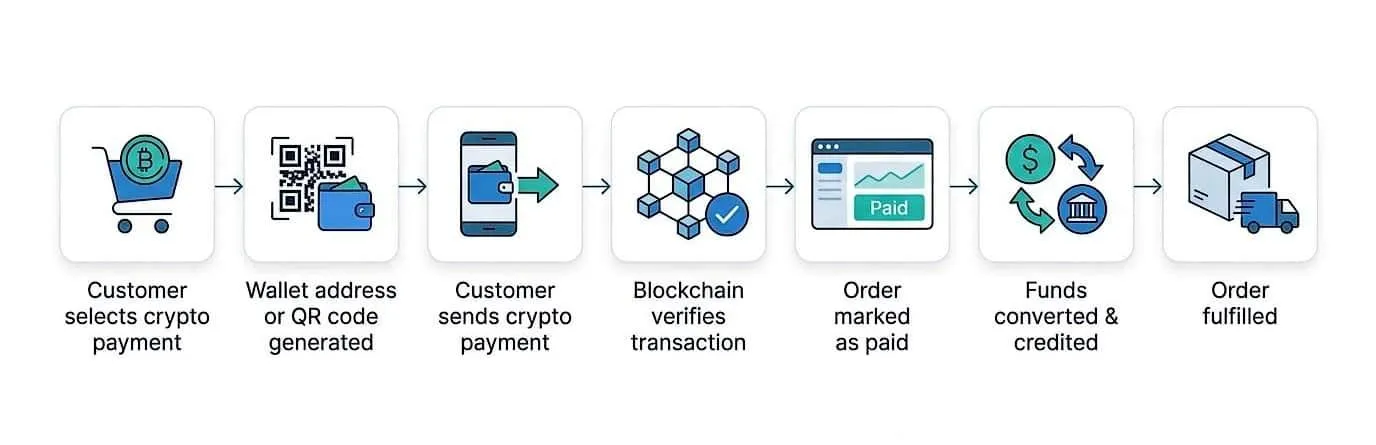
- At checkout, the customer selects crypto as a payment method, and the system creates a transaction request connected to that order.
- The processor then generates a unique wallet address or QR code to facilitate the transaction. These are usually one-time and include the exact amount the customer is paying in the chosen coin.
- The customer uses their crypto wallets to send the funds and pay for the purchased products.
- The blockchain processor verifies the transaction to confirm the receipt of the sent crypto funds.
- After confirming the funds, the processor sends a webhook or plug-in update to your e-commerce platform that changes the order status to “paid”.
- You can now instantly convert the crypto to your currency of choice and credit your balance. While some providers allow this stage to be instant, others may require you to hold the funds in crypto and convert them after a specified duration.
- Now that the payment is confirmed, you can ship or deliver the product to the customer within the promised duration.
Cross-border wallet interoperability
Despite their global adoption, most digital wallets operate within their domestic markets. For example, Cash App is unavailable for users outside the US and the UK and does not support cross-border transactions to other regions. This limits the wallets’ use for international shopping.
Cross-border wallet interoperability addresses this challenge by enabling customers to use their preferred digital wallets to make purchases with international merchants without needing separate payment accounts or unfamiliar payment methods. For example, Alipay+ operates as a unified wallet gateway that allows customers to use their preferred local home wallet to pay merchants globally. This cross-border wallet interoperability can reduce payment friction, improve checkout conversion, and expand access to international customers.
Localisation of payment methods
Localised payment methods remove payment barriers, especially for customers in cross-border markets. They allow customers to pay for products in their local currencies using common local payment methods. As a result, they improve conversion rates, lead to repeat business, and build trust.
Cart abandonment is a major issue faced in cross-border ecommerce, especially if customers can’t find a familiar payment method. Customers abandon about 70% of online shopping carts, with payment and checkout issues contributing to the highest number. At the same time, 99% of cross-border shoppers want to use their preferred payment methods, while 94% expect to complete transactions in their local currencies. So, if you’re targeting international customers, offering localised methods can contribute to the success of your e-commerce brand.
One method you can use to offer localised payment options is to partner with a global payment processor like Antom. With Antom, you can provide localised payments in over 200 markets where it supports over 300 payment methods and 140 currencies. This diversity allows e-commerce brands to reach and deliver to more domestic and international customers, thus achieving higher revenue growth.
AI-powered personalisation in e-commerce
Modern-day customers are looking for experiences and interactions that feel targeted. A report indicates that 71% of customers would shop more from retailers offering personalised experiences. In addition, 98% of online retailers offering personalisation saw higher average order value (AOV) while 71% recorded an ROI of at least 400%. These numbers highlight the growing importance of delivering personalised shopping experiences that improve customer engagement, increase conversions, and encourage repeat purchases.
E-commerce businesses can achieve this success with AI-powered personalisation. AI technologies allow businesses to analyse customer behaviour, purchase history, browsing patterns, location, and payment preferences in real time. With these insights, they can offer personalised shopping experiences that improve customer satisfaction and strengthen long-term brand loyalty.
Final takeaway
Retail payments for cross-border ecommerce are evolving due to changes in consumer behaviour and technological advancements. As e-commerce platforms become accessible in more parts of the world, customers expect frictionless payment processes. This means providing localised payment methods that allow them to complete transactions using familiar options that they already trust. If you’re planning to expand your e-commerce business to more markets, do your research and ensure you implement a payment strategy that aligns with your business goals but also meets customer expectations.
Ready to scale your cross-border retail payments with Antom? Contact us now.
FAQs
1. How can a business measure the success of its cross-border retail payment strategy?
There are various metrics that can show you how your cross-border retail payment strategy is performing, such as cart abandonment rate and customer retention. If more customers are not completing their transactions at checkout, then you may need to assess your strategy and the payment methods offered.
2. Can offering too many payment methods negatively affect checkout?
While customers appreciate the choice to make payments in their preferred methods, presenting too many options can be overwhelming and complicate the checkout experience. So, once you identify your target markets, prioritise offering the most relevant payment methods to keep the payment process flexible and simple.