


Share on
Indonesia's digital payment penetration has surpassed 89%, with the number of users projected to exceed 200 million by 2028. To accelerate the development of its digital payments ecosystem, the country introduced Quick Response Code Indonesian Standard (QRIS), a unified national QR code standard. By integrating a wide range of digital payment services, QRIS has significantly streamlined the payment experience. With strong government support driving its adoption, the use of QR code and mobile payments continues to rise across Indonesia. Building on the QRIS infrastructure, some e-wallet providers have expanded into value-added services such as lending and savings products.
QRIS was launched on 17 August 2019 by Bank Indonesia (BI) and the Indonesian Payment System Association (ASPI). Since 1 January 2020, BI has mandated that all payment service providers adopt the QRIS standard. By consolidating QR codes across participating e-wallets and banking apps, QRIS enables consumers to make seamless payments using a single code. The system also supports cross-border payments and has established interoperability with national QR payment schemes in Singapore, Thailand, Malaysia, and the Philippines.
As a standardised, single QR code for all payment methods, QRIS simplifies integration for merchants and developers alike. Merchants working with participating payment providers can accept payments through QRIS, reducing technical complexity while eliminating consumer confusion when choosing between different e-wallets.
To date, QRIS is used by over 54.1 million consumers and 34.7 million merchants in Indonesia, across sectors including retail, e-commerce, food and beverage, transport, and general commerce. Its rapid adoption is reshaping Indonesia's digital payments landscape.
Properties
The following table lists the product properties supported by QRIS:
Payment type | Real-time payment | ||
Acquirer | AntomSG, AntomUS | Refund | ❌ |
Merchant entity location | SG, HK, US | Partial refund | ❌ |
Buyer country/region | Indonesia | Refund period | ❌ |
Processing currency | IDR | Time to return refund result | ❌ |
Payment flow | Code-scanning | Time to return payment result | Real-time |
Minimum payment amount | IDR 300 | Chargeback/Dispute | ❌ |
Maximum payment amount | IDR 20,000,000 | Default timeout | 5 minutes |
User experience
Note: The following payment flows on different terminals are for reference only. For supported merchants' terminal types, consult Antom Technical Support.
The following screenshots show the journey of paying with QRIS through app.
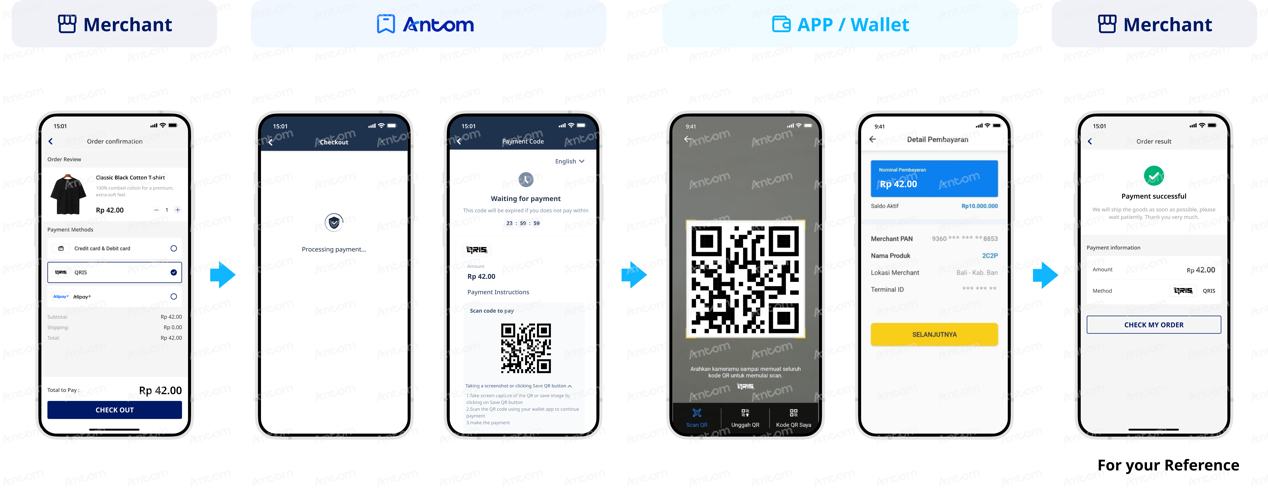
1. The buyer selects QRIS to pay.
2. The payment loading page is displayed.
3. Antom provides the payment information page, allowing the buyer to save a screenshot of the QR code.
4. The buyer scans the QR code with a bank app or digital wallet app that supports QRIS.
5. The buyer verifies the payment details and confirms the payment.
6. The buyer is redirected to the merchant's result page.
FAQ
1. How many QRIS codes can a merchant have?
A merchant can have multiple QRIS codes, enabling them to track transactions across different store locations.
2. Do merchants need to register with OVO, DANA, or GoPay before applying for QRIS?
No. Merchants can activate QRIS through any supported payment service provider, without the need to pre-register with specific e-wallet platforms.
3. Is there a fee to activate QRIS?
Yes. A one-time activation fee of IDR 30,000 applies, which includes a unique code for the soft-copy interactive QRIS.
4. Does QRIS support cross-border payments?
Yes. QRIS is interoperable with payment systems in Indonesia, Malaysia, the Philippines, Singapore, and Thailand, enabling cross-border QR payments.
5. What are the benefits of QRIS for consumers?
- Greater convenience – Consumers only need to scan a single QR code, without needing to switch between different payment apps;
- Enhanced security – QRIS uses encryption and authentication mechanisms to reduce fraud risk during transactions.
6. What are the benefits of QRIS for merchants?
- Broader payment acceptance – A single QR code enables merchants to accept payments from multiple e-wallets and banking apps, helping drive footfall;
- Lower operational costs – Integration of multiple payment methods reduces the need to invest in and maintain separate systems;
- Improved customer experience – A simple and seamless payment process enhances customer experience, which improves customer satisfaction, encourages repeat purchases, and reduces cart abandonment.