
Share on
Gaming payment processing solutions rarely get the attention they deserve. Yet for many gaming businesses, payment friction can directly affect conversion rates, player retention, and spending. Constant issues like failed top-ups, limited local payment options, and poor support for subscriptions can make it hard to scale across markets.
If you run or manage a gaming business, how you handle payments can build or break your business. In this case, media payments should be a strategic tool for strengthening retention, conversion, and revenue growth. This involves selecting proper payment methods, monetisation flows, and proper practices that attract investors as well as global players and an audience that trusts your services and products.
Gaming payments market size and trends
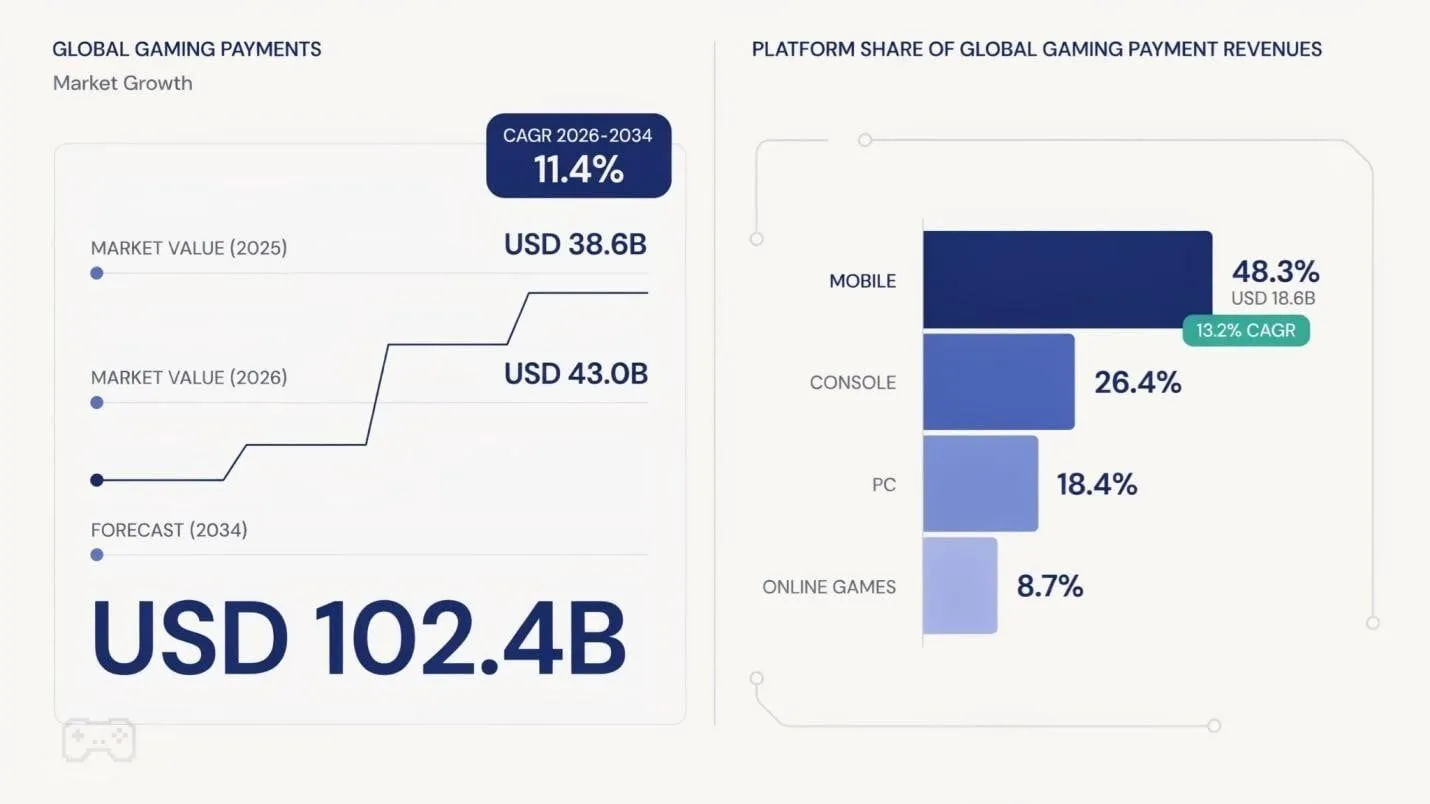
With more people getting into gaming, demand for games and their associated products and services continues to grow. As a result, the global gaming market size shows significant growth patterns. In 2025, its market value was USD 38.6 billion and will reach USD 43 billion in 2026. It will continue to grow at a compound annual growth rate (CAGR) of 11.4% to reach USD 102.4 billion by 2034.
Understanding platform differences in gaming enables businesses to see how payment behaviours vary across channels, including how, when, and how often players spend. The mobile platform accounts for the largest gaming payments by transaction volume, with a market share of 48.3% of global revenues (USD 18.6 billion). They will continue to grow at a CAGR of 13.2% through 2034, thus maintaining the dominant position. Console gaming platforms accounted for 26.4% of the global gaming payment revenues. PC games account for 18.4% of the market share, while online games are an emerging segment with 8.7% of the global gaming payment revenues.
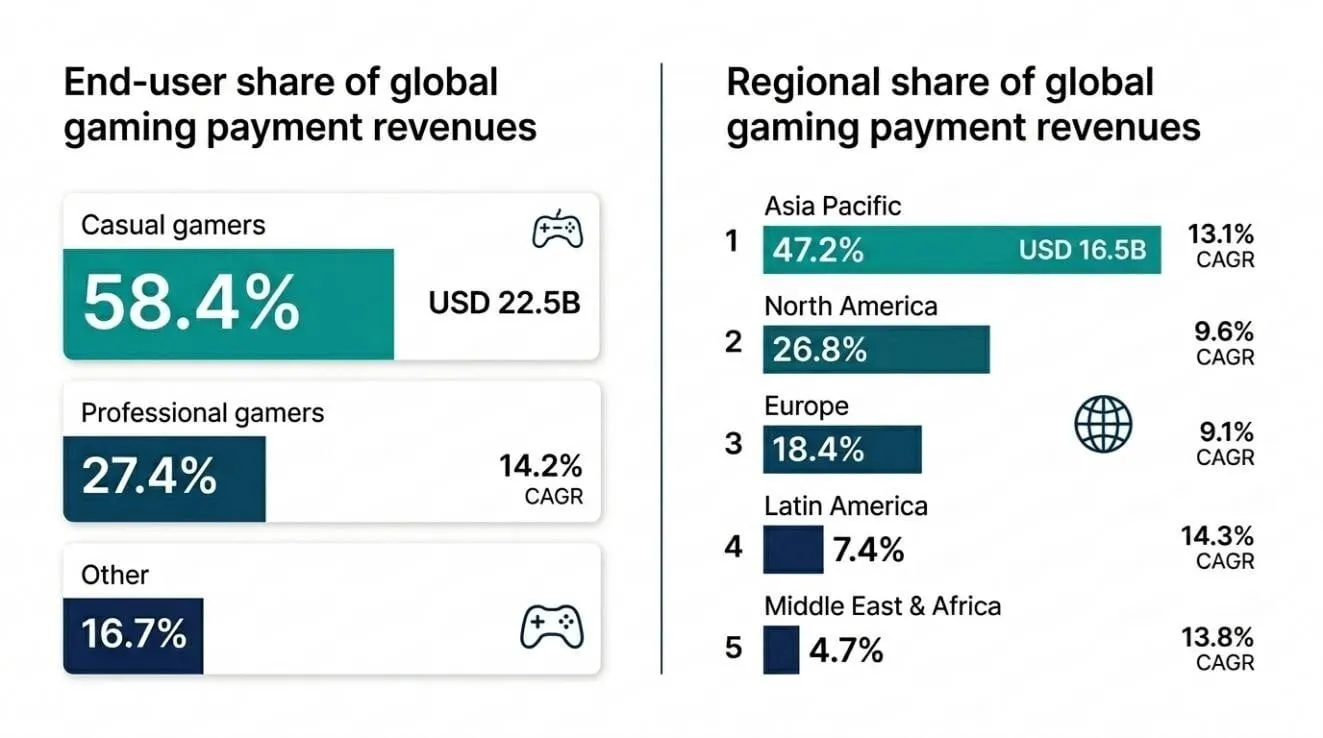
Casual gamers represent the largest end-user segment contributing to this gaming payments growth, with a market share of 58.4% of total gaming payment revenues or USD 22.5 billion. Professional gamers make up the second largest group with a market share of 27.4%. However, projections show that this group will grow at a CAGR of 14.2% through 2034. The other segment accounts for 16.7% of the global revenues. This includes actors like game publishers, gaming venue operators, and platform operators. Therefore, gaming businesses should not build their payment strategies around a single player profile and should accommodate multiple player segments.
Regional comparison of the growth patterns
Regional differences in gaming payments matter because player spending patterns, platform usage, and preferred payment methods can vary significantly by market. The Asia Pacific region dominates the global gaming payments market with a market share of 47.2%, equivalent to USD 16.5 billion. North America is the second largest market at 26.8% of global revenues, followed by Europe at 18.4%.
Latin America holds a market share of 7.4% while the Middle East & Africa (MEA) holds 4.7% of the global market. However, these regions will have the highest growth rate at a CAGR of 14.3% for Latin America and 13.8% for MEA compared to 13.1% Asia Pacific, 9.6% North America, and 9.1% Europe. This projected growth indicates that supporting localised media payments in these regions could help you capture new player spending and build market presence before competition intensifies.
Payment methods for gaming media payments
As a global merchant, your target customers can be from multiple regions across the world. This means that you have to embrace different media payments to accommodate their diverse needs. As a result, integrating multiple payment methods can help increase your conversion rates and reduce payment friction.
Payment method | Market data and relevance | Business considerations |
Digital wallets | Digital wallets account for the largest payment market in gaming, with a market share of 34.2%. This is equivalent to a market value of USD 13.2 billion. | Digital wallets offer convenience through gaming-specific features like instant top-up, rewards tied to in-game currency spending, and payment sharing programs among players. |
Cards | Credit and debit cards account for a 28.5% of the global gaming payment revenues. | They are the preferred payment methods for high-value transactions and remain a preferred payment method for older gamers and those registering new gaming accounts due to the ability to save information for recurring billing. |
Bank transfers | Bank transfers account for 10.3% of the total global gaming payment revenues. | They are common among gamers from markets with strong bank transfer systems like the UK, Brazil, and the European Union. |
Cryptocurrencies | Cryptocurrencies are merging payment methods with a market share of 4.1% of global revenues. Projections show they will continue growing at a CAGR of 22.7% through 2034. | Cryptocurrencies are eliminating cross-border friction, lowering transaction fees, and providing privacy. |
Prepaid cards | Prepaid cards have a market share of 8.6% of the global revenues. | Gamers with parental spending controls, underbanked, and conscious about privacy prefer using prepaid cards. |
Gaming monetisation models and payment flows
If you want to maximise your sales and increase conversion rates, you should combine multiple monetisation models instead of relying on a single revenue stream. For example, if you’re a publisher, you can sell premium titles, offer downloadable content, run a recurring membership programme, and generate ongoing in-game spend from virtual items or currency top-ups. In this case, media payments in gaming need to support different transaction types, purchase frequencies, and risk profiles rather than a single, standardised payment flow.
Model | Payment flows |
Subscriptions and memberships | Users pay for game subscriptions, season passes, battle passes, VIP memberships, or access-based content. |
Premium game and DLC sales | It gives gamers access to one-off purchases for full games, expansion packs, downloadable content, premium editions, and pre-order bundles. |
In-game purchases and virtual currency | This model involves frequent low-value transactions for skins, boosts, consumables, loot boxes, where permitted, virtual items, and top-ups of in-game currency. |
Marketplace or platform transactions | This model is for payments linked to user-generated content, item trading, creator ecosystems, or platform-based transactions where players buy from other users or third-party sellers through the gaming platform. |
What to look for in a payment partner for gaming businesses
When choosing a payment partner, you need to consider more than adding more ways for players to pay. This is because your payment service provider can affect your monetisation models and payment approval rates across different markets. In addition, media payments for gaming businesses often involve managing risks that come with digital goods, recurring billing, and high-frequency transactions. So, here is a checklist to consider before you select your partner:
Global acquiring and local payment method coverage
Even if your operations are in a single market, you may have to sell to players in multiple countries. This means that you will need a payment partner with global acquiring capabilities and strong local payment method coverage to support local checkout preferences, improve authorisation performance, and reduce friction for cross-border buyers.
For example, Antom is a unified AI-powered payment platform that serves in over 200 markets. It also offers more than 300 payment methods and 140 currencies. Working with such a partner would allow you to offer localised payment options, thus increasing conversion rates and overall game usage.
Fraud prevention
As a global gaming merchant, you will encounter multiple risks ranging from account takeover to friendly fraud, promo abuse, reseller activity, and suspicious virtual item purchases. These can all affect revenue and player trust. As a result, a suitable payment partner should offer fraud controls that reflect digital goods risk rather than only physical retail patterns. That includes the ability to monitor unusual spending behaviour, flag account-level anomalies, and reduce fraudulent activity without creating so much friction that it blocks legitimate players at checkout.
Payment optimisation and approval-rate support
High payment acceptance matters in gaming because revenue often depends on repeat purchases, global reach, and frictionless digital checkout. A payment partner should help improve authorisation rates, reduce avoidable declines, and support smoother payment performance across issuers and markets. For example, if a player’s payment fails while buying a battle pass or topping up in-game currency during a limited-time promotion, optimised payment routing or retry logic can help recover the transaction before you lose the sale. Payment optimisation may include smart routing, retry logic, tokenisation, local acquiring support, or tools that help merchants identify where payment failures are occurring and how to address them.
Reporting, reconciliation, and cross-border operational support
As your gaming business grows, your payment flows will become more complex. You will need more visibility, clear reporting, and reconciliation. So, when selecting your ideal payment partner, check how easy it is to access data like transaction performance, chargebacks, refunds, recurring billing outcomes, and payment method usage across regions. Can they handle multiple currencies, local payment methods, subscriptions, or marketplace-style flows? Such strong operational support can reduce back-office complexity and make it easier to manage growth across markets.
Final takeaway
As a global merchant evaluating media payments in gaming, your priority should be on building a payment mix that fits how players actually pay in each market and how your business monetises over time. This means that you will need to invest in payment infrastructure that supports multiple monetisation models. You also need to consider aspects like local payment preferences, recurring billing, microtransactions, and the operational complexity of selling digital goods across borders.
Need a payment partner built for global gaming growth? Contact us now.
FAQs
1. When do anti-money laundering (AML) and sanctions controls become more relevant for gaming businesses?
AML and sanctions controls become more important when a gaming business handles cross-border payments, virtual currency flows, marketplace transactions, or seller and creator payouts. The more a platform moves beyond simple direct game sales, the more likely it is to face additional compliance and screening expectations.
2. Do media payments pose any reputation risks for gaming businesses?
Yes. If a gaming business’s payment setup leads to failed transactions, unclear billing, fraud-related incidents, or poor refund handling, it can damage player trust and create friction in key markets.
3. How often should gaming businesses review payment risk rules across markets?
Reviewing payment risk rules should be a regular practice for all gaming businesses, especially when entering new markets, launching new monetisation features, or seeing shifts in chargeback or fraud patterns. A rule set that works for premium game sales in one region may be too aggressive or too weak for microtransactions in another.