
Share on
International trade payment terms define how exporters and importers agree to settle payments in cross-border trade transactions. In global markets, choosing the right payment terms is important for balancing payment risk, non-payment risk, and business growth.
Exporters should evaluate different payment methods such as advance payments, open account terms, documentary collection, letters of credit, and consignment, depending on the buyer and seller relationship.
Because international trade involves cross-border transactions, currency differences, and varying legal systems, payment risk management becomes a core part of trade finance strategy.
Understanding international trade payment terms helps businesses improve invoice recovery, reduce financial exposure, and optimize payment methods to support sustainable international market expansion.
Payment Terms ≠ Incoterms
A common source of confusion in international trade in international trade is confusing payment terms with Incoterms, even though they govern different aspects of a transaction.
What Payment Terms Actually Define
Payment terms determine how and when money is paid in an international trade transaction.
They answer questions such as:
- When is payment made?
- How is payment executed?
- Who receives the funds?
- Under what conditions is payment triggered?
A typical example is:
30% T/T in advance, 70% T/T against copy of Bill of Lading (B/L)
This means:
- The buyer pays 30% upfront before production or shipment
- The seller ships the goods after receiving the advance
- The remaining 70% is paid once the buyer receives the shipping document (Bill of Lading copy)
In short, payment terms control the flow of money.
What Incoterms Actually Define
Incoterms (International Commercial Terms) define who is responsible for goods, transport, insurance, customs clearance, and risk transfer during shipment.
Common examples include:
- FOB (Free on Board)
- CIF (Cost, Insurance and Freight)
- DAP (Delivered at Place)
- DDP (Delivered Duty Paid)
According to the International Chamber of Commerce (ICC), Incoterms are a set of 11 three-letter trade rules used to define responsibilities between buyers and sellers in international transactions.
The U.S. International Trade Administration also explains that Incoterms define how costs, risks, and logistics responsibilities are divided between trading parties during shipment.
In general:
Payment terms primarily govern payment timing and conditions, while Incoterms primarily govern delivery responsibilities, costs, and risk transfer.
These two systems operate in parallel but govern different dimensions of the same transaction.
The Main Types of International Trade Payment Terms
The most common international trade payment terms include:
- Cash in Advance
- Open Account Terms
- Documentary Collection
- Letters of Credit
- Consignment
Each method represents a different allocation of risk, control, and liquidity between buyers and sellers:
Cash in Advance (Lowest Risk for Exporters)
Cash in advance requires the buyer to pay before goods are produced or shipped. This is generally one of the lowest-risk structures for exporters because it reduces buyer non-payment risk before shipment.
However, it reduces buyer flexibility and can limit sales conversion, especially in competitive global markets.
Open Account Terms (High Buyer Flexibility)
Under open account terms, goods are shipped first, and payment is made after delivery, typically within 30–90 days.
This structure improves buyer cash flow but can increase exporter credit risk.
Cash Flow Impact Example:
For a $100,000 order:
30% advance + 70% before shipment:
- The seller receives $30,000 upfront and $70,000 before shipment
- Total cash received before shipment: $100,000
In most cases, this means the exporter does not need to rely on external financing before goods are shipped, assuming production costs are covered progressively during the order cycle.
Open Account (60 days):
- The seller produces and ships goods first
- Payment of $100,000 is received 60 days after shipment
- Production and logistics costs (e.g., raw materials, labor, transport) are typically funded upfront by the exporter
This creates a working capital gap, meaning the exporter temporarily finances the buyer until payment is received.
Payment Structure | Cash Collection Timing | Working Capital Impact | Risk Level (Exporter) |
30% advance + 70% before shipment | Before shipment | Low working capital pressure | Low |
Open Account (60 days) | 60 days after shipment | High working capital gap | High |
Longer payment terms increase the time gap between cost outflow and cash inflow.
As a result, exporters often rely on trade finance tools such as factoring, supply chain finance, and export credit insurance to manage liquidity pressure.
Documentary Collection (D/P & D/A)
Documentary collection involves banks acting as intermediaries for document exchange and payment.
- D/P (Documents against Payment): Buyer pays upon document release
- D/A (Documents against Acceptance): Buyer accepts draft and pays later
Banks do not guarantee payment, meaning risk still exists for exporters.
Letters of Credit (Bank-Backed Security)
Letters of Credit provide a bank-backed payment undertaking, helping exporters reduce counterparty risk when the required documents and agreed conditions are properly met. This reduces counterparty risk and is often used in high-value or high-risk transactions.
Consignment (High Risk for Exporters)
In consignment, goods are shipped but payment is only made after resale to the final customer. This can create significant cash flow pressure for exporters but reduces buyer risk significantly.
Payment Terms vs Cash Flow: Why It Matters in Real Trade
Payment terms strongly influence the timing mismatch between cash outflows (costs) and cash inflows (revenue) in international trade. This mismatch is one key reason payment terms can affect working capital and liquidity.
In real export transactions, exporters usually often need to pay for production materials, manufacturing, packaging, logistics, and shipping before they receive any payment from the buyer. This means cash is going out of the business first, while cash is only coming back later based on the agreed payment terms.
The longer the payment cycle—for example, under Open Account terms where payment may be delayed by 30–90 days—the longer exporters must use their own funds (or external financing) to keep the business running. In effect, exporters are temporarily financing the buyer’s purchase until payment is collected.
This creates a working capital gap:
- Cash leaves the business immediately (production + logistics costs)
- Cash returns later (after shipment or after credit period)
- The gap between these two creates liquidity pressure
This is why international trade relies on financial bridging tools
Because exporters cannot always wait for payment while funding operations upfront, they use trade finance mechanisms to convert delayed receivables into usable cash:
- Trade finance → provides upfront liquidity for production and shipment
- Factoring → converts unpaid invoices into immediate cash
- Export credit insurance → reduces risk of buyer default and supports financing
- Supply chain finance → allows early payment to suppliers while extending buyer terms
These tools help exporters bridge the gap between shipment and payment collection.
How to Evaluate Whether a Payment Term Favors Buyer or Seller
In international trade payment terms, payment structures are rarely neutral. They shape how risk, cash flow pressure, and control are distributed between buyers and sellers.
A practical way to evaluate any payment term is through three key questions:
Step 1:Who acts first in the transaction?
If the buyer pays before production or shipment (e.g., cash in advance), the seller has stronger cash flow protection and lower risk exposure.
If the seller ships goods before receiving payment (e.g., open account), the buyer benefits from improved liquidity, but the seller assumes credit risk and potential non-payment exposure.
Step 2:Is there a bank payment guarantee?
A Letter of Credit (L/C) provides a bank-backed payment commitment, meaning the exporter is paid once contractual conditions are met.
In contrast, Documentary Collection methods (D/P or D/A) involve banks only as intermediaries, not guarantors, meaning credit risk remains with the trading parties.
Step 3:Does payment occur before goods release?
If payment is required before documents or goods are released, seller risk is usually lower.
If goods are released before payment (open account or consignment), the buyer gains control first, increasing seller exposure to delayed payment or default.
The International Trade Payment Terms Triangle
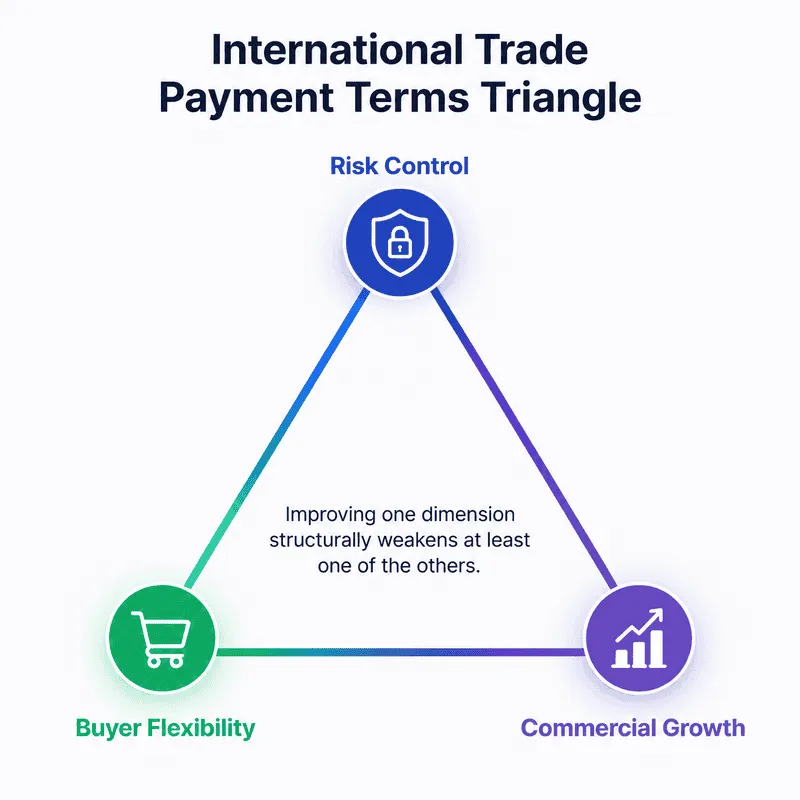
International trade payment terms represent a strategic trade-off between three core objectives: risk control, buyer flexibility, and commercial growth.
Cash in advance gives exporters stronger risk control by ensuring payment is received before shipment, but it reduces buyer flexibility and may limit order volume in competitive markets. At the opposite end, open account terms and consignment increase buyer flexibility and support sales growth, but expose exporters to higher payment risk and working capital pressure. Documentary collection and letters of credit provide a more balanced structure by combining partial risk mitigation with operational and banking complexity.
These trade-offs form the international payment terms triangle:
- Risk control: payment security and predictability
- Buyer flexibility: ease of purchasing without cash constraints
- Commercial growth: ability to drive conversion and long-term demand
Improving one dimension usually creates trade-offs with at least one of the others, because payment risk and cash flow timing are allocated differently between buyer and seller.
However, in real-world global commerce, most merchants do not rely on a single payment method. Instead, they operate across multiple markets, currencies, and buyer segments simultaneously, which means different transactions often require different payment structures.
This creates a deeper operational challenge: even when exporters understand the trade-offs of each payment term, they still need a way to orchestrate and optimize payment performance across fragmented payment rails, local preferences, and varying risk profiles.
This gap between payment strategy (what terms to choose) and payment execution (how payments actually get processed and optimized across markets) is where modern payment infrastructure becomes a key consideration.
How Antom Helps Optimize International Trade Payment Terms
In modern global commerce, payment decisions are no longer static. Businesses operate across multiple markets, currencies, and payment infrastructures.
This is where payment orchestration platforms such as Antom become a relevant infrastructure layer.
Antom helps global merchants optimize the trade-off between risk control, buyer flexibility, and commercial growth by enabling intelligent payment routing, local payment method coverage, and multi-currency settlement across markets.
Instead of forcing businesses to rely on a single payment structure, Antom can help merchants manage payment channels more dynamically and support improvements in areas such as:
- Payment acceptance rates
- Cross-border transaction success rates
- Settlement efficiency
- Risk visibility and control
This can help merchants reduce operational friction and build a more flexible payment strategy and build a more flexible and scalable global payment strategy.
Summary
International trade payment terms are not just financial mechanisms—they define how risk, liquidity, and growth are distributed between global buyers and sellers.
Understanding payment structures such as cash in advance, open account, letters of credit, documentary collection, and consignment is important for many cross-border businesses.
However, in modern commerce, a growing priority is not only choosing a payment method, but also optimizing the broader payment flow.
Platforms enable this transition by helping businesses balance risk, flexibility, and growth across global markets.