
Share on
South Korea is a highly mature digital market, with near-universal internet access and the share of digital payment transactions growing rapidly. In this landscape, the quality of the payment experience plays a decisive role in commercial competitiveness. Despite the explosive growth of digital wallets, bank-based payments and transfers remain deeply entrenched in the financial habits of most Korean consumers. However, traditional online banking payment processes, which often involve multiple redirects to bank pages and the use of security plugins or hardware password authenticators, are widely regarded as cumbersome, making them one of the primary sources of friction and transaction abandonment in e-commerce. Against this backdrop, South Korea's open banking policy has provided critical infrastructure for payment innovation, enabling payment processes to be securely reintegrated into merchant environments through standardised interfaces.
Express Bank Transfer (known locally in Korea as "퀵계좌결제") is a direct product of this policy that addresses consumer needs. Rather than introducing an entirely new payment method, it redefines the user experience of direct account payments, a well-established, nationwide practice. Its core innovation lies in streamlining a previously fragmented, multi-redirect authorisation process into a simple two-step flow completed entirely within the merchant's page. This deep level of integration has improved payment success rates by approximately 20% compared with traditional online banking methods, directly addressing Korean consumers' dual expectations of convenience and reliability.
For merchants, the value of this service lies in its broad accessibility and high conversion efficiency. It does not require a credit card, but only a Korean bank account. This enables seamless access to an existing user base of more than 50 million bank customers. This is particularly important for high-ticket sectors such as e-commerce, digital entertainment, and travel, where reducing payment-stage drop-off is critical to revenue performance. In a mature market with projected average annual e-commerce spending exceeding USD 2,600 and where 82% of consumers express willingness to engage in cross-border shopping, optimising every step of the bank payment journey translates directly into measurable revenue growth.
Properties
The following table lists the product properties supported by Express Bank Transfer:
Payment type | Online banking | ||
Acquirer | AntomSG, AntomUS, AntomEU, AntomUK, AntomHK | Merchant entity location | SG, HK, US, UK, EEA |
Buyer country/region | South Korea | Refund | ✔️ |
Time to return payment result | Real-time | Partial refund | ✔️ |
Processing currency | KRW | Chargeback/Dispute | ❌ |
Minimum payment amount | 200 KRW | Refund period | 180 days |
Default timeout | 14 minutes | ||
Maximum payment amount[2] |
| ||
[1] Luxury goods: The unit price of each transaction is greater than or equal to 2,000,000 KRW.
[2] The payment amount limits in the table are for buyers.
User experience
Note: The following payment flows on different terminals are for reference only. For supported merchants' terminal types, consult Antom Technical Support.
The following screenshots show the journey of paying with Express Bank Transfer in different scenarios:
First-time payment
Web
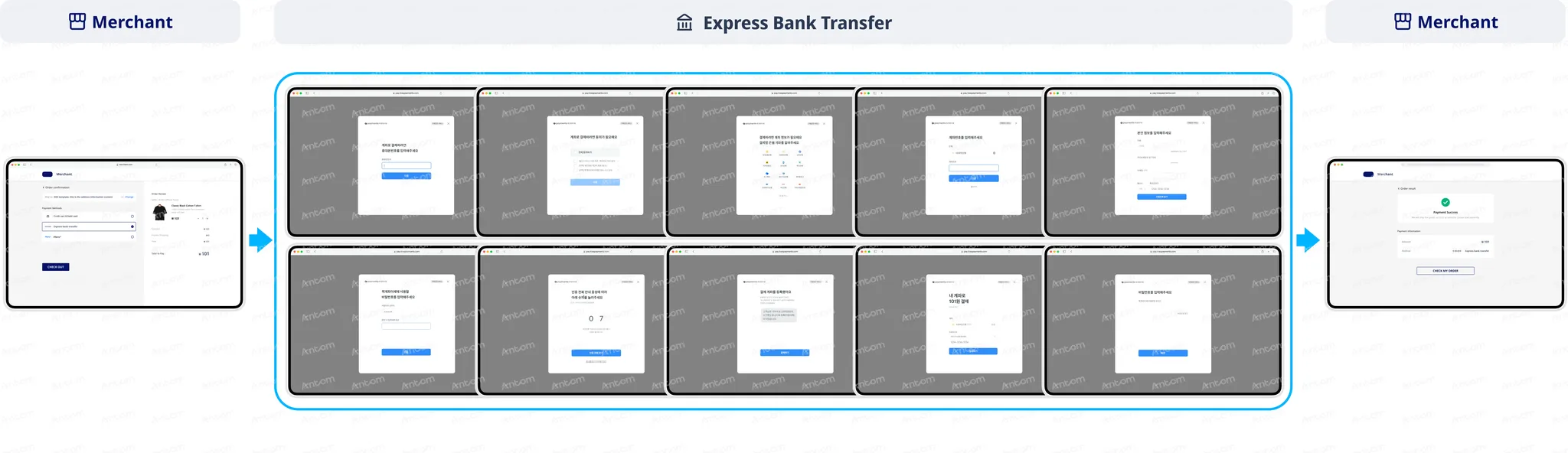
- The buyer selects Express Bank Transfer to pay.
- The buyer enters the mobile phone number to identify whether they are first-time registered buyers and starts the registration process.
- The buyer confirms service terms.
- The buyer selects the bank to which the bank account is to be bound.
- The buyer enters the bank account number.
- The buyer enters the personal information.
- The buyer sets a 6-digit payment password (for Express Bank Transfer).
- The buyer receives an institution phone call and enters the numbers on the phone according to the call guidance.
- The buyer is notified that the account has been successfully linked.
- The buyer confirms the order information and bank account used for this payment.
- The buyer enters the payment password.
- The buyer completes the payment and is redirected to the merchant page.
WAP
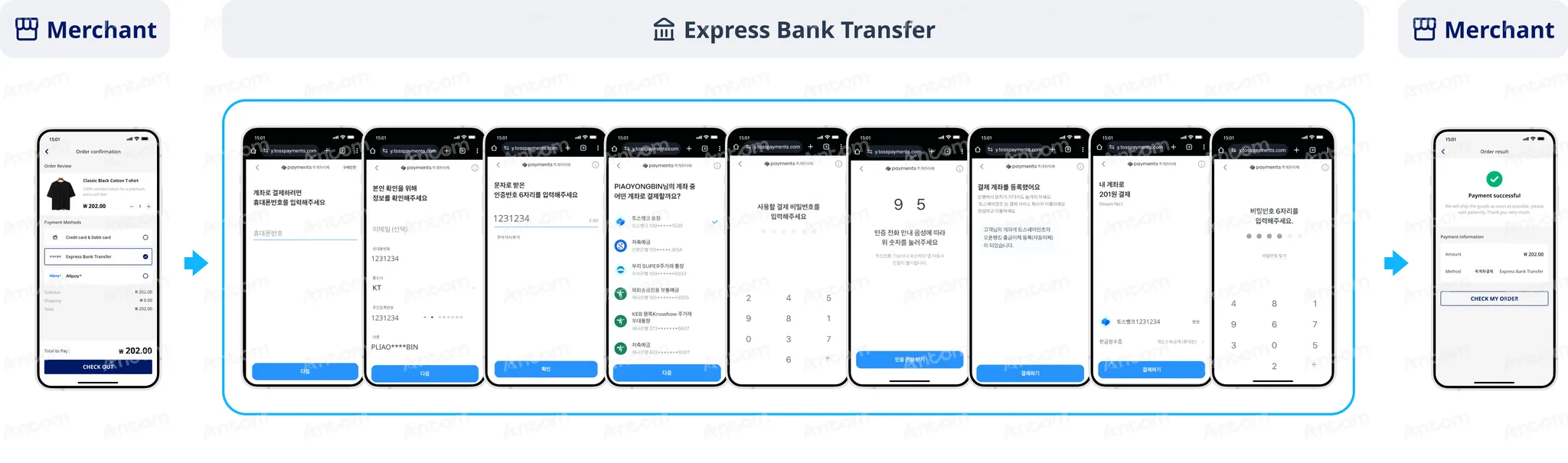
- The buyer selects Express Bank Transfer to pay.
- The buyer enters the mobile phone number to identify whether they are first-time registered buyers and starts the registration process.
- The buyer enters the personal information.
- The buyer completes the OTP authentication.
- The buyer enters a bank account number; buyers who have already registered with Toss Pay wallet app can directly obtain the previously bound bank account to expedite the process.
- The buyer sets a 6-digit payment password (for Express Bank Transfer).
- The buyer receives an institution phone call and enters the numbers on the phone according to the call guidance.
- The buyer is notified that the account has been successfully linked.
- The buyer confirms the order information and bank account used for this payment.
- The buyer enters the payment password.
- The buyer completes the payment and is redirected to the merchant page.
Subsequent payments
Web
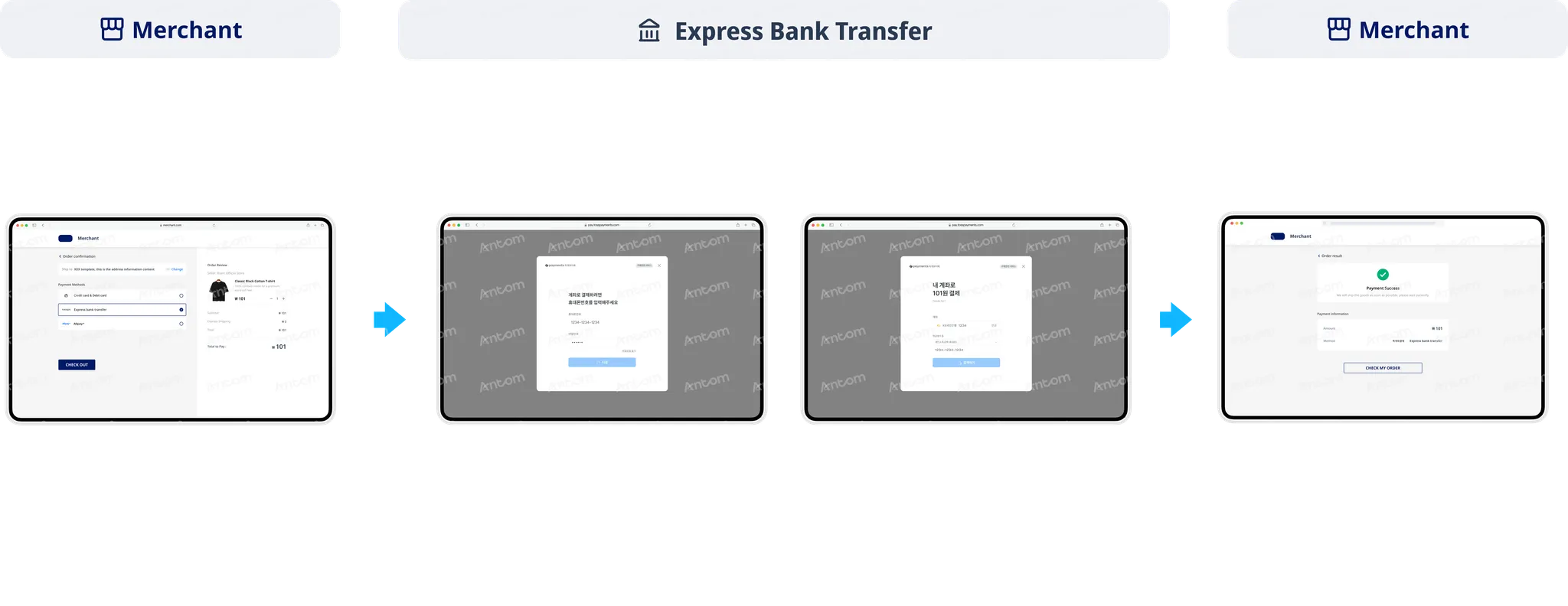
- The buyer selects Express Bank Transfer to pay.
- The buyer enters the mobile phone number and 6-digit password.
- The buyer confirms the order information and bank account used for this payment.
- The buyer completes the payment and is redirected to the merchant page.
WAP
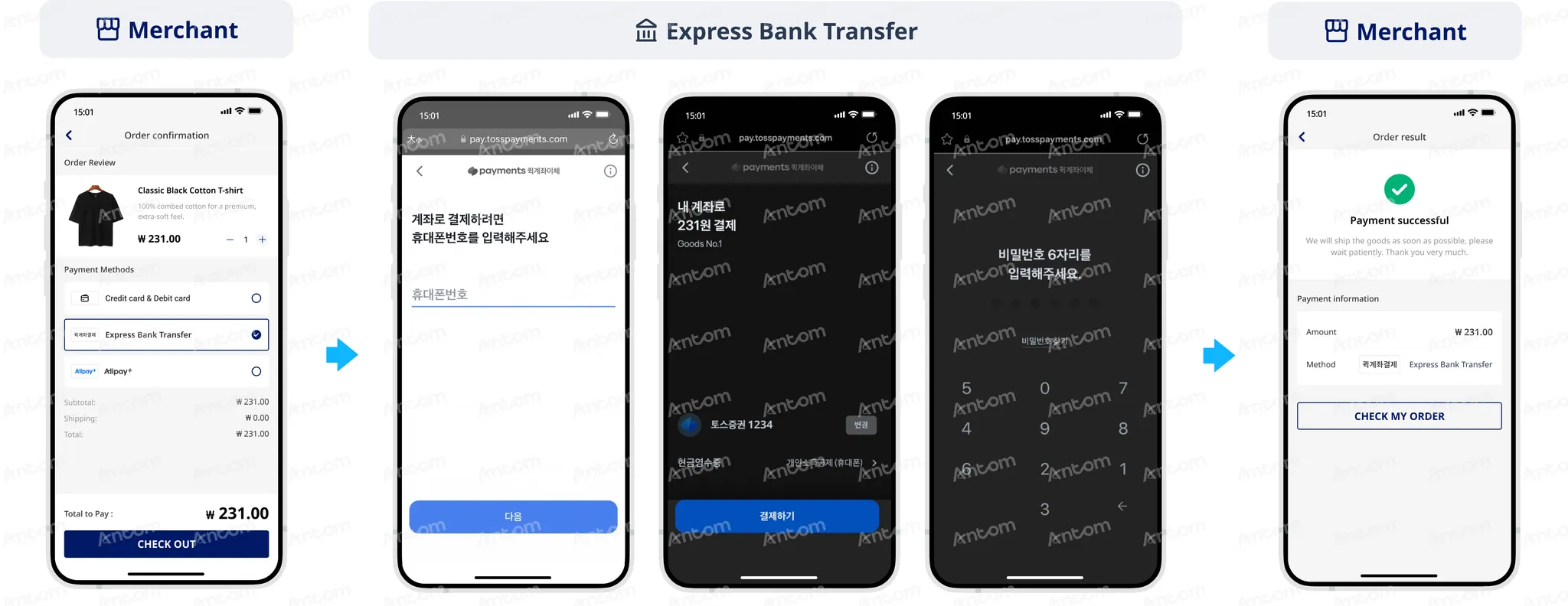
- The buyer selects Express Bank Transfer to pay.
- The buyer enters the phone number.
- The buyer confirms the order information and bank account used for this payment.
- The buyer enters the payment password.
- The buyer completes the payment and is redirected to the merchant page.
New account binding for existing buyers
Buyers who have already registered and bound previous accounts can also add extra accounts. User flows here show the extra accounting binding process for existing buyers.
Web
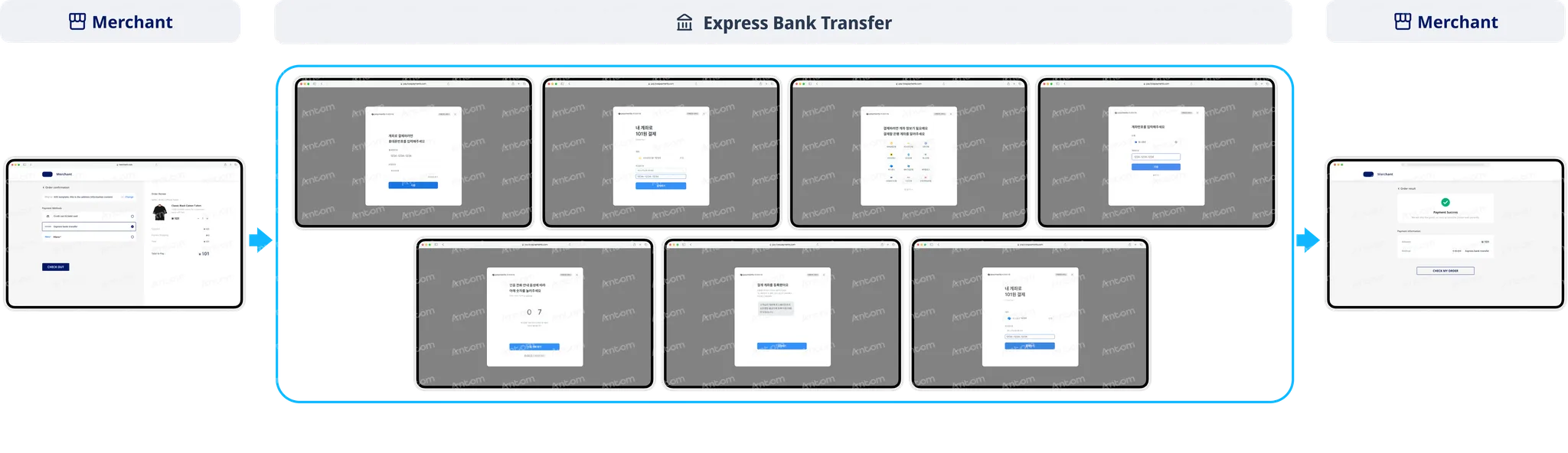
- The buyer selects Express Bank Transfer to pay.
- The buyer enters the mobile phone number and 6-digit password.
- The buyer drops down account information to select a new account.
- The buyer selects the bank to which the bank account is to be bound.
- The buyer enters the bank account number. Buyers who have already registered with Toss Pay wallet app can directly obtain the previously bound bank account to expedite the process.
- The buyer receives an institution phone call and enters the numbers on the phone according to the call guidance.
- The buyer confirms the order information and bank account used for this payment.
- The buyer enters the payment password.
- The buyer completes the payment and is redirected to the merchant page.
WAP
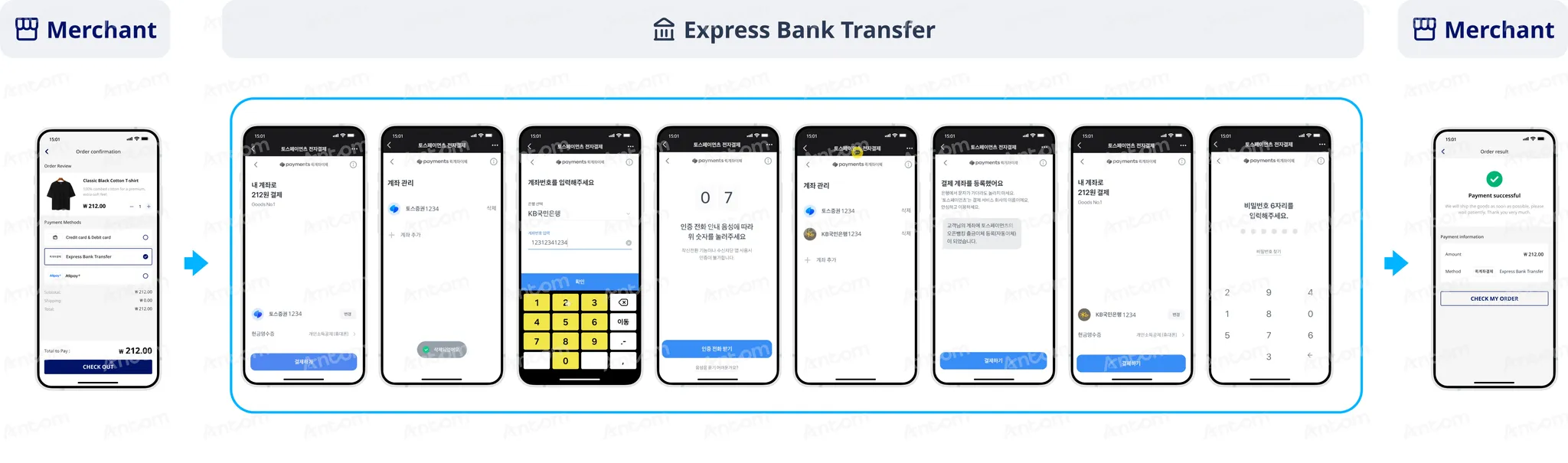
- The buyer selects Express Bank Transfer to pay.
- The buyer drops down account information to select a new account.
- The buyer selects the bank and enters the bank account.
- The buyer receives an institution phone call and enters the numbers on the phone according to the call guidance.
- The buyer is notified that the account has been successfully linked.
- The buyer confirms the order information and bank account used for this payment.
- The buyer enters the payment password.
- The buyer completes the payment and is redirected to the merchant page.
FAQs
What safeguards does South Korea's Open Banking policy provide for payment methods, and what does this mean for merchants in terms of fund security?
South Korea's Open Banking policy is led by financial regulators and requires banks to securely share data and services with certified third-party providers via standardised, regulated APIs. As a result, Express Bank Transfer operates on bank-grade security protocols and remains fully embedded within the banking system, rather than bypassing it. For merchants, this layer of protection translates directly into reduced fraud and card skimming risks. Every authorisation is verified and logged directly by the issuing bank, ensuring full traceability of transactions and further bolstering the security and credibility of the bank payment ecosystem.
Which consumers are more likely to use Express Bank Transfer?
Express Bank Transfer primarily serves two groups. The first comprises users who do not hold credit cards or who prefer to pay directly from their debit cards. The second includes users who are highly sensitive to the quality of the checkout experience and prefer stable processes without repeated page redirects. Anyone with a Korean bank account can use Express Bank Transfer, so it offers access to more than 50 million potential users, particularly those who are already familiar with online banking but expect a smoother and more streamlined bank payment experience.
From an operational perspective, what do industry-specific transaction limits tell us about South Korea's risk management practices?
Express Bank Transfer applies differentiated daily and monthly transaction limits across sectors such as gaming and top-ups, luxury goods, and general retail. This reflects Korean payment providers' granular, risk-based approach to operations, grounded in industry-specific risk profiles and anti-money-laundering (AML) requirements. For example, lower limits for gaming and top-up merchants are consistent with standard controls for high-frequency, low-value virtual transactions. By contrast, luxury goods merchants are granted higher daily caps to accommodate the high-ticket nature of physical e-commerce. By clearly identifying their merchant category during onboarding, merchants can access a payment configuration aligned with their business model and transaction characteristics.
Beyond improving conversion rates, can Express Bank Transfer help optimise operating costs?
Yes. One of its core advantages lies in its comparatively low payment processing costs. Its transaction fees are typically lower than those of local Korean credit cards and digital wallets. For high-volume or high-ticket merchants, this can effectively reduce the total cost of payment acceptance. In addition, chargebacks are not applicable to this payment method, so merchants are not required to set aside dispute reserves or allocate dedicated resources to chargeback management, as is common with credit card transactions. Over time, this supports a more predictable and controllable payment cost structure.
Connect to Express Bank Transfer through Antom to deliver a more stable bank transfer experience and reach South Korea's broad base of account-based payment users.