
Share on
Working through business transactions can take up a lot of a business owner’s time. Between the processing and the paperwork, you can easily lose hours to endless calculations. Thankfully, we live in a digital-first world, and one of its best perks is digital payments. They let you pay local and international stakeholders in just minutes.
Because there are no intermediaries or physical cash involved, money moves seamlessly. And you’re finally caught out of the calculation web. This article takes a deeper look into B2B transactions and what the future holds for them.
Let’s find out!
What Are Digital Business Payments?
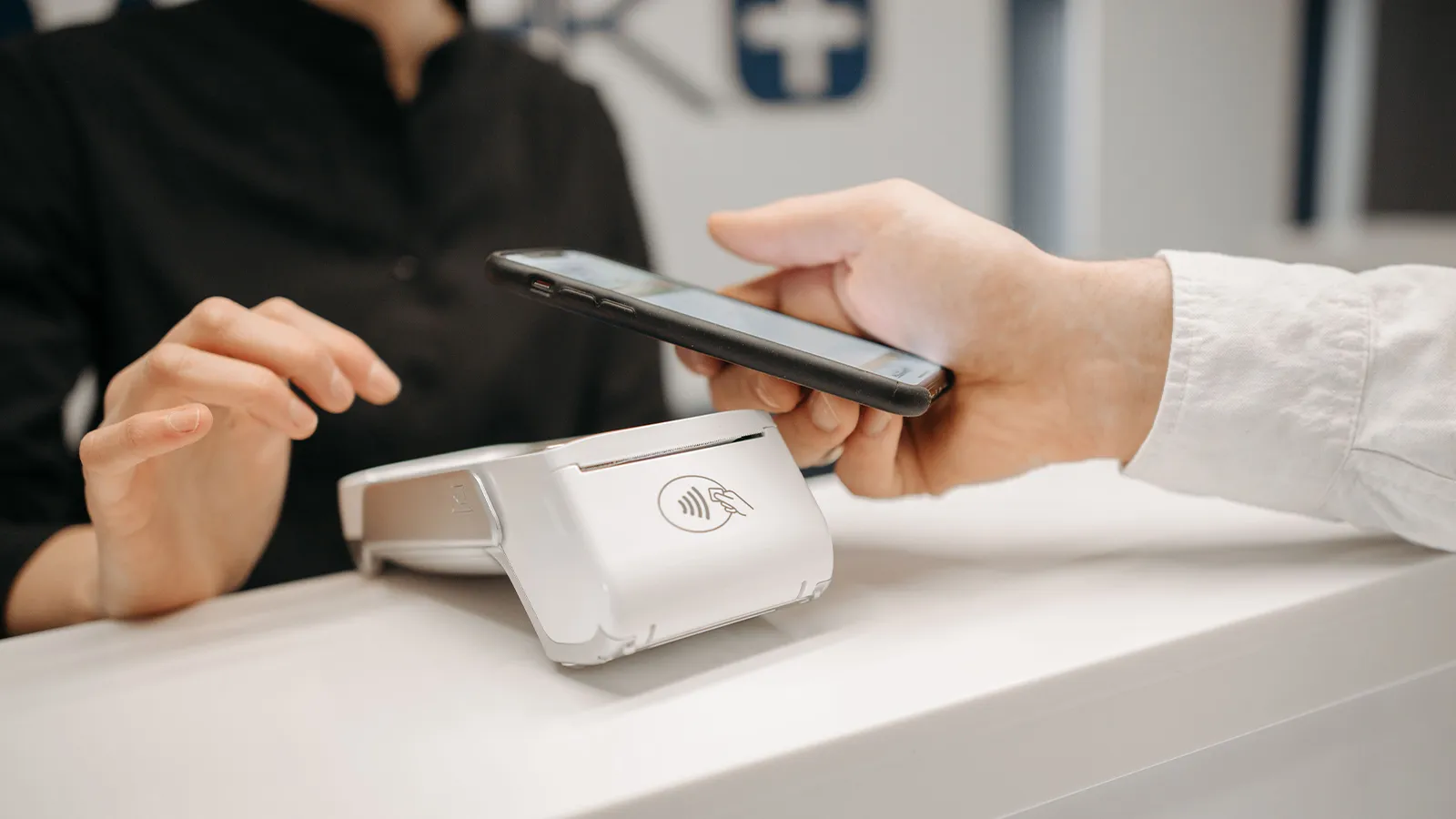
A digital payment is any financial transaction that moves money entirely electronically. It cuts paper checks, physical invoices, and cold hard cash out of the equation.
If money moves via code instead of a clipboard, it’s digital. This could be as simple as a quick tap on a mobile phone or instant cross-border digital wallets. Regardless of the method, the core is that this is the money you can’t touch. Yet, it very much exists.
Behind the scenes, money is converted into secure data tokens. They can travel instantly across digital highways. As a result, there are no long waiting times for checks to clear.
This shift to digital payments is what businesses need to survive in this fast-moving economy. According to a Convera industry report, global business-to-business transactions move an astonishing $120 trillion annually. Yet, traditional, non-digital channels remain a major bottleneck. 26% of business decision-makers admit they have outright stopped working with a supplier/buyer due to delayed payments.
Traditional vs. Digital Business Payments at a Glance
If you still believe traditional payments are your way to go and digital payments aren’t your cup of tea, the comparison below might help. A good look at how they differ can give you a better perspective:
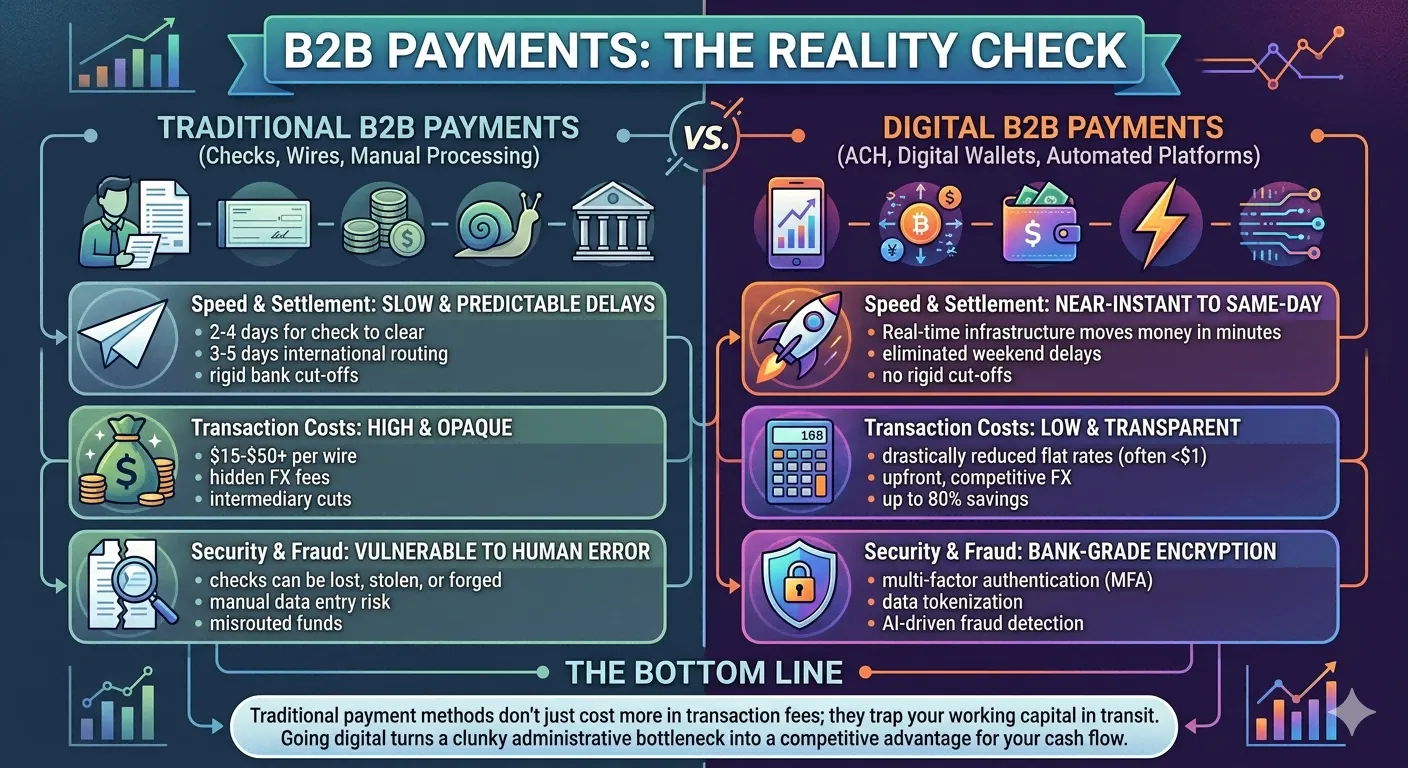
The whole admin work involved in traditional payments can eat up your time and money. Digital business payments can overcome all security and calculation errors with their sophisticated algorithm.
Top B2B Digital Payment Methods
Now that we’ve established why paper is out and digital is in, let’s look at the actual tools doing the heavy lifting. You don’t need to use every single method out there. But knowing how they work ensures you pick the right tool for the job.
Account-to-Account (A2A) Transfers
As the name suggests, account-to-account (A2A) payments are a way of moving money from one bank account to another. No intermediaries, such as card networks or payment processors, are involved in these transfers.
Generally speaking, this happens in one of two ways:
- Push payments (You send it): This is where you, the payer, decide. You log into your online banking, type in the recipient’s details, and send. Because you have to authorise it every time, this is the go-to method for one-off invoices.
- Pull payments (They collect it): In this scenario, the recipient pulls the funds from your account with your permission. This is like a standard direct debit setup. You authorise it once at the beginning. And, from then on, the platform automatically collects the money on a set schedule. Checking out platforms like Antom will be a wise move at this point. It allows users to pay for streaming and gaming directly from their bank accounts. They don’t have to go through traditional card networks.
Hence, A2A acts as a direct connection between businesses, removing the complexity of traditional card networks.
Digital Wallets and Local Payment Methods (LPMs)
If you think digital wallets are just for buying coffee with your phone, think again.
In the B2B world, digital wallets and localised payment networks are exploding in popularity. They’re particularly used for cross-border transactions and for paying global business partners.
According to WorldPay’s Global Payments Report, digital wallets already account for more than half of the value of global e-commerce transactions in several markets. This reflects how businesses are widely accepting the new payment modes.
The catch here is that regional preferences vary.
While one partner in Europe prefers SEPA, a contractor in Southeast Asia might rely on an e-wallet like GrabPay or Touch 'n Go. Therefore, a business should closely scan the market. Look at what their potential stakeholders prefer and find a way to meet their needs.
Next-Gen Virtual Cards
Virtual cards are exactly like the plastic corporate card in your wallet. Their USP is that they exist entirely online, as 16-digit numbers generated for specific transactions.
You can create a virtual card exclusively to pay a specific software subscription or set a strict spending limit for a temporary contractor. They give finance teams massive control over expenses. Also, they offer top-tier security since the real account details are never revealed unless you enter a code.
You don’t have to wait for the physical card to arrive in your post. The whole card generation can happen in seconds:
- Instant Creation: You request a card through your payment platform. Within seconds, a 16-digit number is generated.
- Setting the Guardrails: You can set limits before anyone spends a penny. This means setting a budget or choosing specific businesses as recipients.
- The Guardrail Check: The system processes it like a traditional card at the checkout. It instantly checks it against your preset rules. If the requirements aren’t met, the transaction is rejected.
- Smart Data Capture: The transaction goes through, and because that card was assigned to a single project or vendor, all the expense data is automatically organised for easy reporting.
- Self-Destruction: Once the purchase is made or the expiration date hits, the card completely shuts down. Even if a hacker stole the number, it is entirely useless.
If you are dealing with several international businesses, a virtual card is the way to go.
Automated Cross-Border Gateways
When you are moving high-volume funds across continents, standard bank wires can trap your cash in transit for days while racking up unpredictable intermediary fees.
The scale of this shift (wire to digital transfers) is massive. Cross-border spending is projected to skyrocket from nearly $195 trillion in 2024 to a staggering $320 trillion by 2032.
Modern cross-border payment platforms are completely rewriting the traditional banking playbook. Rather than routing money through an expensive chain of intermediary banks across different continents, these platforms connect directly to local payment networks worldwide.
When a business initiates a transfer, the system instantly calculates local currency conversions and compliance checks in the background. It moves the funds entirely through optimised digital rails.
Antom is worth mentioning at this point. It bridges these global gaps by allowing businesses to manage over 300 local payment methods and 100+ currencies through a single integration point. Its routing and AI-driven foreign exchange (FX) tools allow a business to bypass traditional banking bottlenecks entirely.
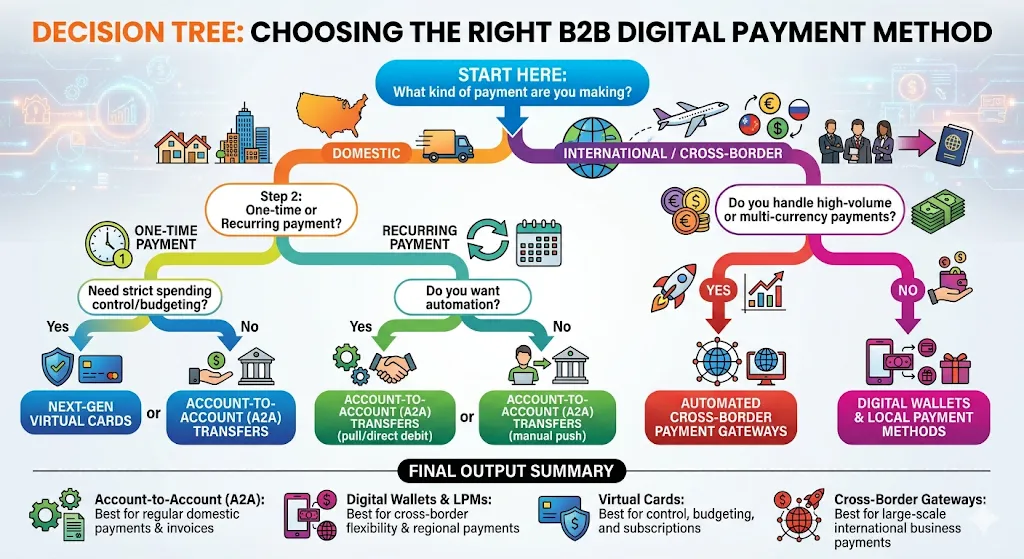
This leads us to an understanding that choosing a reliable digital payment method is essential. You shouldn’t simply follow what everyone else is adopting. Take some time to weigh your options, then select a digital payment method that checks all the “requirement” boxes for your business.
A decision tree, like the one below, might help:
Conclusion
At the end of the day, managing your business transactions shouldn’t feel like a second full-time job. All those hours spent swimming in a sea of manual calculations and untangling messy paperwork are hours stolen from what you actually do best. That is, growing your business.
The digital payment revolution is shifting the entire operational workflow into the fast lane. Innovative payment processors like Antom are redefining how global businesses manage transactions. It is getting effortless to scale across borders and channels.
So, don't wait for your next billing bottleneck to force your hand. Take a close look at your current payment setup this week. Spot where the manual friction is hiding, pick the digital tools that match your goals, and finally get yourself out of the calculation web for good.
Your peace of mind (and your bottom line) will thank you!
Frequently Asked Questions (FAQs)
1. How long do digital B2B payments take to clear?
Gone are the days of waiting 3 to 5 business days for a paper check to travel through the post and clear. The standard domestic transfers usually settle within 1 to 2 days. On the other hand, modern digital wallets and automated gateways can move funds near-instantly or on the exact same day.
2. Are digital payments actually safe for large business transactions?
Absolutely, they are more secure than old-school paper checks.
Modern digital payment platforms use bank-grade encryption and data tokenisation to mask your real banking details. Moreover, the automated systems use AI-driven fraud detection to scan for anomalies. They will block suspicious transactions before any money leaves your account.
3. How do digital payment platforms protect my business from exchange rate spikes?
When you use a digital cross-border payment gateway, you can completely bypass the inflated exchange rates that traditional banks love to hit you with at checkout. Instead, the platform taps into real-time, AI-driven foreign exchange tools to lock in competitive rates right upfront.
Having that kind of transparency means no guessing games. You’ll know exactly how much local currency is landing on the other side before you even hit send.