

Share on
The rapid evolution of technology has led to significant growth in the global eCommerce industry. For instance, data projections show that the cross-border eCommerce market value will grow from USD 551.23 billion in 2025 to USD 636.34 billion in 2026. It will continue growing at a compound annual growth rate (CAGR) of 15.44% through 2034.
However, accepting payments from international clients can be a challenge for most cross-border merchants. Consumer preferences across regions vary, thus impacting their willingness to complete online transactions. For example, consumers in certain regions may prefer bank transfers, while others opt for digital wallets or local payment methods they know and trust. As a business owner, you need to adopt a payment system that integrates multiple payment methods to cater to your diverse customers’ preferences.
Global payment methods market analysis
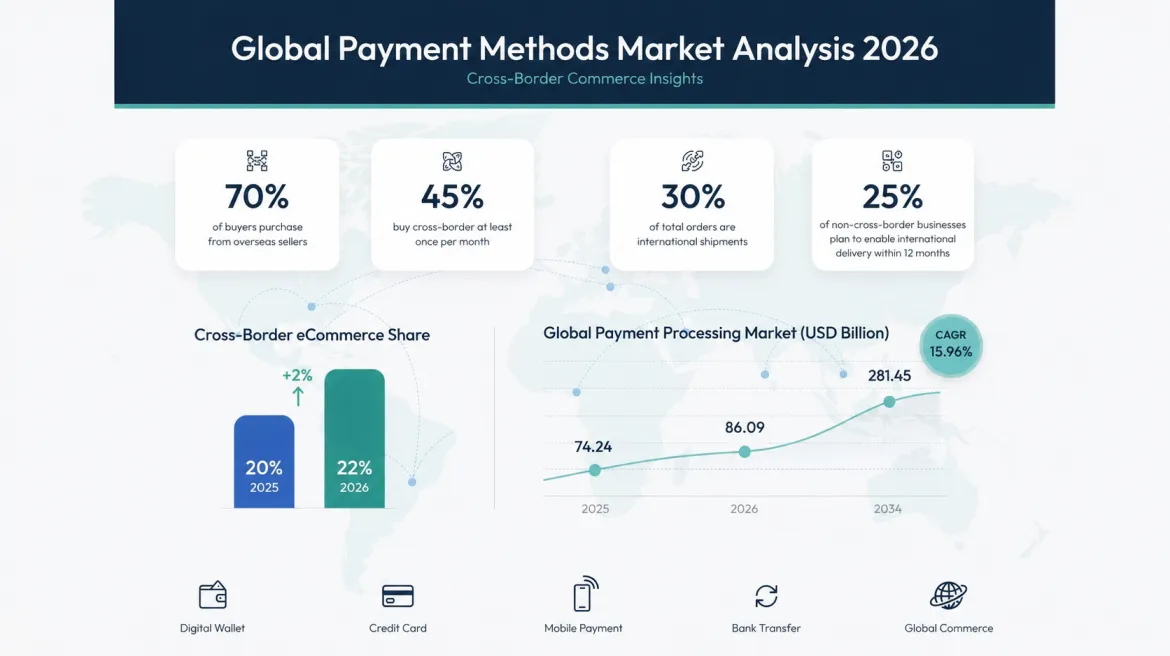
According to industry estimates, 70% of buyers purchase from overseas sellers, with about 45% of them buying across borders at least once per month. In addition, more than 30% of orders processed go to international destinations. Among businesses that are not selling cross-border, 25% plan to prioritise building international delivery capabilities within the next year. As a result of this growth, cross-border sales accounted for 20% of the total eCommerce market in 2025, and projections show this number will increase to 22% in 2026. These numbers reflect the growing recognition of international commerce as a growth mechanism for most businesses.
The global payments industry must evolve alongside this growth of cross-border eCommerce. With businesses increasingly expanding internationally, it has become crucial for them to adopt diverse payment methods. This helps in meeting local consumer payment preferences and reducing friction during checkout.
In 2025, the global value of the payment processing solutions market was USD 74.24 billion. This value will continue to grow at a CAGR of 15.96%, growing from USD 86.09 billion in 2026 to USD 281.45 billion by 2034. The increased adoption of convenient solutions, such as mobile applications, e-wallets, and cards, contributes to this major growth.
Best global payment methods
When you run cross-border businesses, one of the things you must carefully consider is the payment methods. How will consumers in different parts of the world complete their payment transactions when paying for your products or services? When answering this question, you must remember that preferences for and access to different payment methods vary across borders. Therefore, you should consider providing various options to accommodate multiple customer groups.
Mobile money transfers
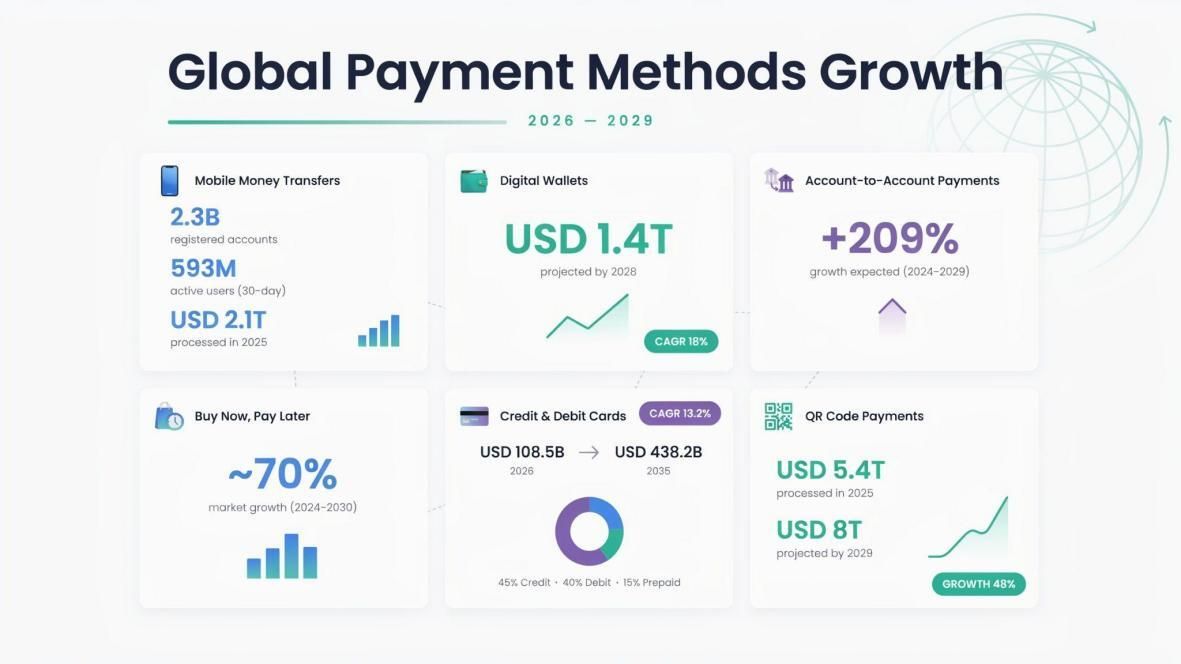
With the increased use of mobile phones, mobile money solutions have become a common payment method for most shoppers. There are about 2.3 billion registered mobile money accounts, with about 593 million active in 30 days. In addition, the mobile money industry processed about USD 2.1 trillion in 2025. These numbers reflect the significant potential of mobile money as a global payment method.
Mobile money solutions allow users to store, send, and receive money through their mobile phones. Most users use mobile money solutions to purchase items online, pay bills, and top up airtime. Some applications also allow money withdrawals at authorised agents.
Digital wallets
Digital wallets or e-wallets are payment methods that allow users to store payment information securely and pay instantly through apps or online platforms. Examples include Apple Pay, Google Pay, Alipay, and PayPal. They’re popular among consumers due to their convenience and ease of use.
Market data shows that by 2028, digital wallets will be processing transactions of up to 1.4 trillion. Between 2024 and 2028, the volume of ecommerce transactions completed through digital wallets will grow at a CAGR of 18%. As a cross-border merchant, this data shows you the potential of integrating digital wallets in your global payment methods. With the projected growth, you can tap into the opportunities to reach more customers and boost your business’s performance.
Bank transfers
Sometimes customers prefer directly transferring money from their bank accounts to the seller’s bank account. This payment method bypasses third-party payment processing networks. Bank transfers are common among B2B customers that process high-value transactions and large bills due to their reliability and low processing risk. However, bank transfers can sometimes be slower compared to instant payment methods.
As a cross-border merchant, you have various types of bank transfers you can integrate into your payment system:
Type of bank transfer | How it works |
Account-to-account (A2A) | Funds move directly between bank accounts domestically or internationally. Projections show A2A global transactions will increase by 209% between 2024 and 2029. |
Wire transfers | These are traditional bank-to-bank transfers commonly used for high-value or international payments. They are secure but can be slower and often come with higher fees. |
Direct debits | Customers authorise a business to collect payments from their bank account on agreed dates. This payment method works well for recurring charges such as subscriptions, memberships, and utility bills. |
Real-time payments (RTP) | RTP enables instant bank-to-bank transfers with immediate confirmation for both sender and receiver. It improves speed, transparency, and payment certainty. |
Buy Now, Pay Later (BNPL) services
BNPL is a good option if you’re planning to give your customers an alternative, flexible payment method. This payment solution allows customers to purchase goods immediately and pay in instalments over time without paying interest.
Industry estimates show that the BNPL market will grow by almost 70% between 2024 and 2030. This growth will allow businesses to reach new customers by making their products or services more accessible through flexible payment plans.
Credit and debit cards
Credit and debit cards remain one of the most widely accepted global payment methods. They are supported almost everywhere and provide strong fraud protection and chargeback mechanisms. Despite growing competition from digital wallets, cards still play a major role in international eCommerce transactions.
In 2026, the global market value of cards is USD 108.5 billion, with projections showing it will reach USD 438.2 billion by 2035, growing at a CAGR of 13.2%. Most consumers (45%) use credit cards, followed by debit cards (40%), and prepaid cards (15%). With about 72% of adults worldwide having access to formal financial services, you should consider integrating cards into your global payment system.
QR code payments
If you’re looking to integrate an even more convenient payment method, consider QR code payments. This approach allows customers to scan a code using a mobile device to complete a transaction instantly. As a cross-border merchant, QR code payments allow you to bypass traditional card networks, eliminate international transaction fees, and reduce physical hardware dependencies.
Industry data reflects the growing effectiveness of QR code payments as a global payment method. For example, QR code payments exceeded USD 5.4 trillion in 2025 and will reach USD 8 trillion by 2029, growing at a rate of 48% between 2025 and 2029. As a business owner, this payment method allows you to connect with global consumers who are increasingly endorsing digital payments that give them access to global markets.
Preferred payment methods in different regions
One mistake many businesses make when expanding internationally is assuming that customers everywhere prefer the same payment method. But a checkout experience that performs well in the United States may struggle in Brazil, Indonesia, or Kenya. This could be because shoppers in these countries are familiar with and trust different local payment options.
Region | Payment methods | How they perform |
North America | Credit/debit cards, digital wallets (Apple Pay, Google Pay, PayPal), BNPL | Credit and debit cards account for the largest transactions. Digital wallets and BNLP are increasingly growing due to the growth of mobile payments and e-commerce transactions. |
Latin America | Digital wallets, cash, bank transfers, real-time payments [RTPs] (such as Pix in Brazil) | There is a decrease in the use of cash, debit, and credit cards. However, there’s a significant growth in the use of RTPs and digital wallets due to digitisation and financial inclusion. |
Asia Pacific | Digital wallets (Alipay, WeChat Pay), QR codes, mobile money, bank transfers | Digital wallets dominate the APAC region due to high internet penetration and a large population of unbanked users, who are leapfrogging traditional bank cards. |
Middle East & Africa | Mobile money, digital wallets, cash, BNPL, and cards | Cash has been the standard payment method in most countries in these regions. However, the rise of fintechs and a younger tech-savvy population are causing a shift towards digital wallets, cards, mobile money, and BNPL. |
How to manage global payment fragmentation
Now that you’re familiar with the global payment methods, how do you integrate them to reduce the complexity of working with multiple solutions?
Managing separate integrations for each payment method and market can quickly become operationally challenging and expensive. As a result, most businesses turn to payment orchestration solutions that consolidate multiple payment methods into a single integration. This allows them to accept multiple payment methods and currencies through a single platform.
An example of this solution is Antom. This global merchant payment and digitalisation platform supports unified integration of payment methods. It allows you to manage different payment providers across different regions in a single platform. For instance, Antom is available in more than 200 markets and supports over 300 payment methods and 140 currencies. This diversity allows you to localise your payment methods so that you can offer more familiar payment options to customers in their local markets.
Frequently asked questions (FAQs)
1. Why is offering multiple payment methods important for cross-border eCommerce?
Offering multiple payment methods helps merchants match local customer preferences, which reduces checkout friction and increases conversion rates in international markets.
2. What is the biggest challenge in managing global payment methods?
The main challenge is fragmentation because different regions prefer different payment systems. This requires businesses to integrate and manage multiple providers and compliance requirements.
3. How do payment preferences impact international sales performance?
Payment preferences directly affect trust and checkout completion rates. Customers are more likely to abandon purchases if they don’t find their preferred local payment method.