


Share on
As a business owner, you may invest heavily in digital marketing campaigns, only to discover that the traffic you receive doesn’t translate into sales. Customers may click advertisements, add items to their carts, but leave before completing a purchase.
In many cases, the problem is not marketing. It is payment friction. Consumers expect familiar payment methods, fast checkout, honest pricing, and most importantly, secure transactions. If those expectations are not met, your conversion rates may dwindle, no matter the effort you put into selling your business.
This guide explains how payment optimisation can reduce cross-border checkout friction, improve customer experiences, and increase conversion rates. You will also learn how combining effective payment strategies with digital marketing strategies can support business growth and maximise revenue opportunities.
Why Payment Optimisation Matters More Than Ever
According to a report by Persistence Market Research, digital commerce continues to expand globally. At the same time, a ResearchGate finding shows that digital wallet adoption is also high, indicating that more consumers are using online payment methods to complete purchases.
It is, however, important to note that customer expectations are changing. Research from the Baymard Institute shows that 70% e-commerce visitors abandon their carts. Among these, complicated checkout experiences remain one of the leading reasons. This means your marketing campaign may successfully attract visitors, but if the payment process isn’t well structured, customers may abandon their purchases at the last minute.
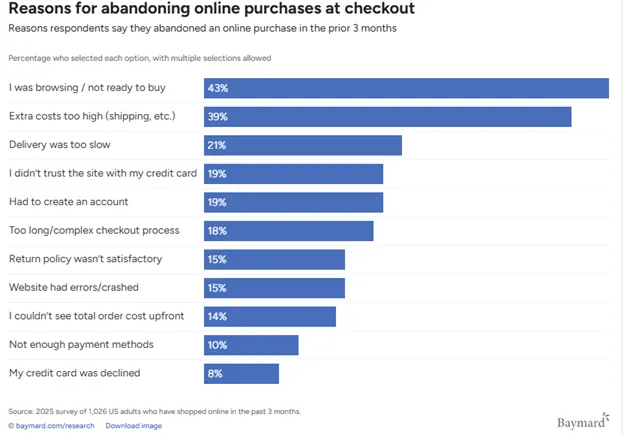
Source: Baymard
From the findings, we can conclude that if marketing and payments are optimised, you’ll have better conversion rates when entering new markets. But how exactly do you achieve this?
1. Localise Checkout with Regional Payment Methods
A successful marketing campaign can attract customers from around the world, but those customers may have very different payment preferences.
Consumers in one region may favour digital wallets, while others rely on bank transfers, cards, or Buy Now Pay Later solutions. Offering only a limited number of payment options can create friction during checkout and reduce conversion rates.
Localising your checkout allows customers to pay using methods they already know and trust. This can increase confidence and improve the likelihood of completing a purchase.
When evaluating payment providers, you should consider whether they support the local payment methods commonly used in your target markets. For example, Antom supports more than 300 payment methods worldwide, helping businesses offer localised checkout experiences while simplifying cross-border payment acceptance.
2. Use Payment Analytics to Reduce Cart Abandonment
Most businesses track website traffic, click-through rates, and advertising performance. However, payment analytics can provide equally important insights.
Payment data can point out:
- Where customers abandon transactions
- Which payment methods have the highest conversion rates
- Checkout steps that are difficult for clients to follow through
For example, if online visitors consistently abandon purchases after selecting a payment method, you can investigate the possible causes to determine issues affecting conversions.
3. Optimise Mobile Payments for Mobile First Customers
Businesses invest in mobile advertising campaigns through social media and even search platforms. However, those efforts may be undermined if the payment experience is not optimised for smartphones and tablets.
A study even shows that mobile commerce accounts for a huge share of online transactions worldwide. This means the easier it is for customers to complete purchases on mobile devices, the greater the likelihood that your marketing will generate better returns.
4. Align Marketing Campaigns with Local Currency
Imagine a client clicking an ad for a product with a specific price, only to discover unexpected currency conversions during checkout. Situations like this may undermine a client's trust.
Displaying prices in local currencies helps customers understand costs. It also creates a smoother purchasing experience and reduces uncertainty during checkout.
So, as your business expands internationally, ensure that its payment systems support local-currency pricing whenever possible. This improves customer confidence and ensures marketing messages are consistent from advertising to purchase.
5. Integrate Fraud Prevention within Customer Acquisition Strategies
In most cases, fraud prevention and customer acquisition are treated as separate business functions. In reality, they are closely connected.
A poor fraud strategy can affect your venture in two ways. First, excessively strict controls may block legitimate customers and reduce conversion rates. On the other hand, weak controls may lead to fraud losses and damage your reputation. You should therefore find a balance between the two approaches.
The good news is that most payment solutions use machine learning technologies to spot suspicious activity. You may also collaborate with your payment provider to customise these measures to make them relevant to your business model. This will help you build trust and minimise disruption for legitimate buyers while protecting revenue generated.
6. Improve Checkout Process
If customers reach the checkout page and discover they must create an account or complete several forms to complete payment, chances are, they will simply leave and look for a more convenient alternative.Every unnecessary checkout step increases the risk of losing potential customers, while a simplified checkout can improve conversion rates.
Depending on your business model, your optimisation strategy may include:
- Guest checkout options
- One-click payment options
- Saving payment credentials to avoid repeating the same steps
- Few payment instructions
7. Secure Payment
Buyer trust is one of the most important factors shaping purchasing decisions. Customers want to be sure that their personal and financial data is secured. If a checkout process appears unprofessional, they may leave without completing the purchase.
Businesses may strengthen trust by having:
- Encrypted gateways: Your payment gateway should encrypt sensitive transaction data and help protect customer information during payment processing. This reduces the chance of data leaks.
- Strong authentication measures: Features such as two-factor authentication and biometric verification can help prevent unauthorised transactions while protecting customer accounts.
- Transparent privacy policies: Customers want to understand how their information is collected and used. Your privacy policies should explain this up front to improve trust.
- Recognisable security indicators: SSL certificates, trust badges, secure checkout icons, and well-known payment logos reassure customers that they are dealing with a legitimate business.
8. Support Cross-Border Expansion with Flexible Acquiring Solutions
Businesses must also consider how payments will be processed in different regions. Flexible acquiring solutions can help improve transaction approval rates and customer experience. This is particularly important when serving customers across several countries and currencies.
When comparing payment providers, businesses should evaluate:
- Global payment coverage
- Local acquiring capabilities
- Settlement options
- Currency support
- Regional expertise
Some of the most widely used global payment providers include Antom, Stripe, Adyen, Worldpay, and PayPal. You may combine multiple providers to increase payment coverage or create redundancy in case one provider experiences disruptions. The best approach depends on your target markets and transaction volumes.
9. Leverage Recurring Payment Models
Subscription payment models help businesses charge clients a specific amount automatically at a predetermined period, e.g., weekly. They are specifically ideal for software, streaming services, digital content, and membership programs.
One of the biggest advantages of recurring payments is revenue predictability. Instead of relying on one-time purchases, your business can generate regular income while building long-term customer relationships. It is therefore easier to retain customers, meaning your marketing campaigns won’t focus solely on acquiring new customers. According to a study, your expenditure will also decrease, since the cost of retaining existing clients is lower than that of acquiring new ones.
10. Measure Payment Performance Alongside Marketing Metrics
Traditional marketing metrics are vital, but they only tell part of the story. To understand the state of your business, consider monitoring payment-specific indicators alongside marketing data.
Important metrics to consider include:
- Transaction success rates
- Authorisation rates
- Chargeback ratios
- Average order value
- Customer lifetime value
- Payment method performance
The data may help your business identify opportunities to improve profitability and optimise both marketing and payment strategies. For instance, if advertising campaigns are generating traffic but authorisation rates are low in a particular market, the issue may not be the campaign itself. Instead, it could indicate a need for additional payment methods, local acquiring support, or a simplified checkout process.
FAQs
Why are local payment methods important for cross-border e-commerce?
Consumers are more likely to complete purchases when they can use payment methods they already trust and use regularly. Supporting local payment preferences can improve conversion rates and buyer satisfaction.
How can payment optimisation reduce cart abandonment?
Payment optimisation reduces friction during checkout by offering preferred payment methods, enhancing mobile experiences, supporting local currencies, and improving payment processes.
What should businesses consider when choosing a payment service provider?
Before settling on a provider, evaluate its security features, fraud management capabilities, local acquiring options, and payment methods it supports. Most importantly, confirm its global reach and whether they offer support for cross-border transactions.
Turn Marketing Success into Revenue Growth
Digital marketing is, without a doubt, an important driver of business growth. However, attracting visitors shouldn't be the final goal. You must also ensure that customers can complete transactions quickly and safely.
That entails partnering with payment providers that support local payment methods, cross-border transactions, fraud management, and global acquiring capabilities to offer a smooth customer experience.
Contact Antom to learn how to simplify your payment solutions to help your business expand into new markets.